
Current Security Challenges & Microsoft's Future Solution
The Growing Gap in Traditional Defenses
In today's threat landscape, security teams face a fundamental imbalance. Defenders must protect every asset perfectly while attackers need just one vulnerability to succeed. Traditional Microsoft Defender responses are inherently reactive. When a workstation gets compromised, automatic attack disruption isolates it effectively.
But attackers don't stop there. They pivot laterally faster than human analysts can respond. This exploits connections to Domain Controllers, credential stores, or sensitive data repositories. It creates a chase game where response lag allows credential theft or data exfiltration in minutes., credential stores, or sensitive data repositories.
Static prevention also fails. Blanket network lockdowns disrupt business operations. Security teams drown in false positives and manual triage. A single compromised jump box can lead to full domain dominance if lateral movement isn't blocked preemptively.
To solve this critical gap, Microsoft Ignite 2025 previewed Predictive Shielding. This represents a proactive evolution of Defender XDR's autonomous protection stack.
What is Predictive Shielding?
Predictive shielding is a proactive defense strategy designed to anticipate and mitigate threats as part of an ongoing attack. In the near future, this capability will anticipate attacker progression. It analyzes threat intelligence, past incident patterns, and your organization's exposure graph.
It applies just-in-time hardening to only the most probable attack paths with no broad disruptions. This bridges pre-breach and post-breach defense with graph-based prediction logic. The precision approach maintains productivity while giving defenders a crucial time advantage.
Predictive Shielding is a brand-new capability just introduced by Microsoft and not yet commercially available. The information in this article is based solely on Microsoft's Ignite 2025 announcements and may be subject to significant changes prior to general availability.
How Predictive Shielding Works
Predictive Analytics & Real-Time Insights: The Foundation
Predictive Shielding uses predictive analytics and real-time insights to dynamically identify emerging risks before they become active threats. Unlike traditional tools that wait for malicious activity, this approach integrates three critical data sources: posture data (your security configuration baseline), activity data (live behavioral signals), and scenario context (current attack patterns).
This combination allows Defender to identify potential attack paths and high-value targets across your environment. Instead of broad, disruptive measures, it selectively hardens critical assets or constrains specific attack paths just-in-time. For example, it could dynamically restrict access to sensitive data for at-risk devices only, eliminating the need for environment-wide lockdowns that disrupt business operations. This precision minimizes operational overhead while giving security teams valuable extra time to investigate and respond.
Pillar 1: Prediction Logic - Understanding Emerging Risks
The prediction pillar focuses on emerging risks rather than static prevention, ensuring security measures apply precisely where needed. Prediction enables organizations to identify at-risk assets and deploy tailored protections in real time with minimal friction.
Defender leverages multiple layers of insight for accurate predictions:
- Threat intelligence aligns observed activity with Microsoft's global database of known attacker tools, tactics, and techniques (TTPs).
- Learnings from past incidents provide statistical pattern recognition to extrapolate next steps.
- Organizational exposure data maps asset connections, permissions, vulnerabilities, misconfigurations, and risk propagation paths.
Example: Detection of a specific attacker tool triggers inference of the next likely target based on historical attack patterns.
Pillar 2: Graph-Based Logic - The Attack Path Battlefield
Graph-based prediction logic bridges pre-breach prevention and post-breach response systems. It overlays post-breach activity onto the exposure graph to reveal potential attack paths. Defender identifies the blast radius of affected assets. Reasoning models predict likely attacker paths based on past behaviors, asset characteristics, and environmental vulnerabilities.
Precision Enforcement: Targeted Just-in-Time Hardening
Enforcement translates predictions into action through Defender for Endpoint actions (license required).
Safeboot hardening prevents Safe Mode booting to bypass controls. GPO hardening secures Group Policy Objects against privilege escalation. Proactive user containment selectively restricts high-risk users (new sessions only, unlike attack disruption).
Managing & Monitoring in Defender Portal
Microsoft Defender leverages predictive shielding as a forward-thinking proactive defense strategy, engineered to foresee and neutralize threats well before they can fully materialize and cause damage.
How to Review Predictive Shielding Details and Results
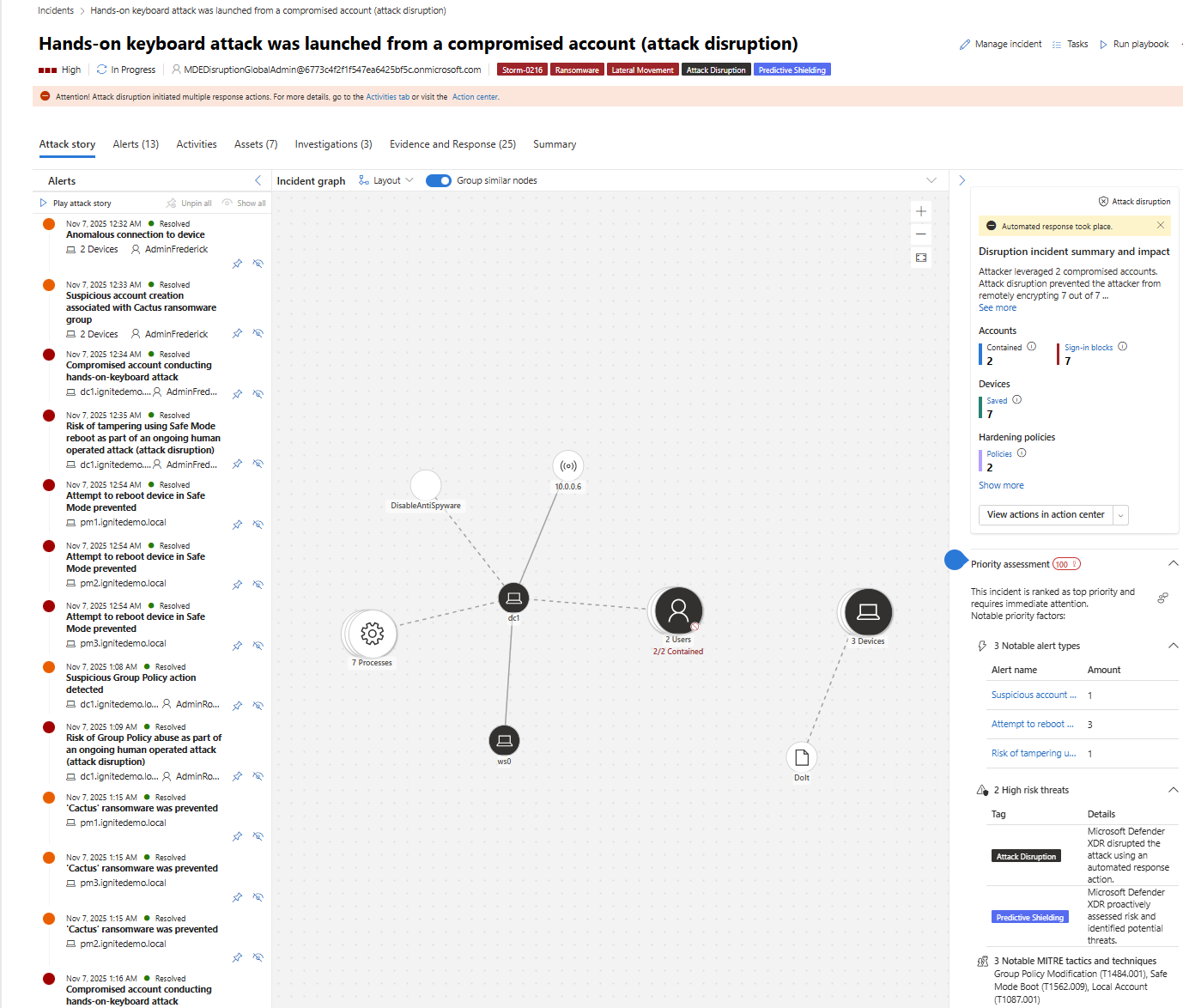
Microsoft Defender's incident view includes built-in predictive shielding information. Use the incident graph and activity data to evaluate shielding impact and current status.
To enhance predictive shielding data, we recommend deploying the Microsoft Defender for Identity sensor for richer security insights and broader coverage.
Review Incident Information
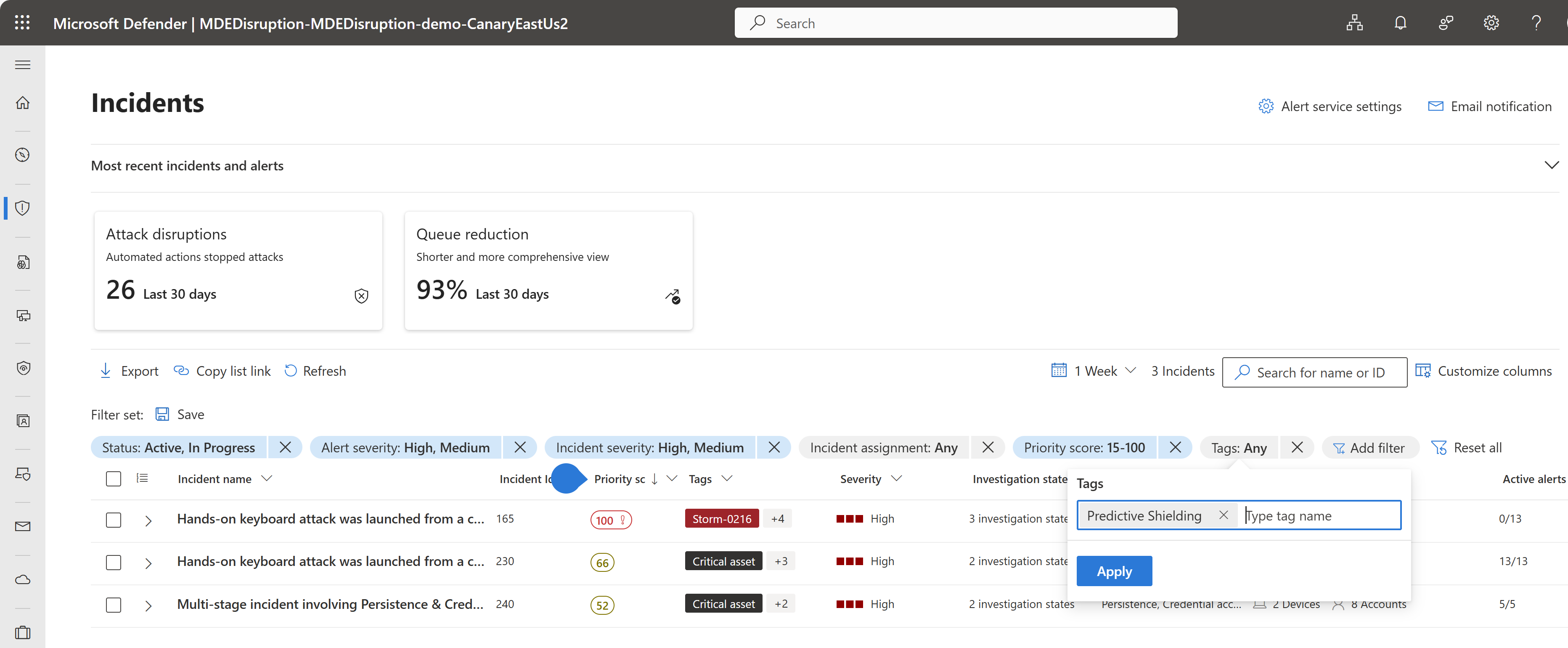
On the Incidents page, apply the Predictive Shielding filter to locate incidents utilizing predictive shielding.
Incident and alert details display historical data from the incident's start, while the Activities tab provides a live status snapshot.
Select the relevant incident to explore the incident graph and full attack story, evaluating predictive shielding's impact and status.
Review Activities Tab
Navigate to the incident's Activities tab and filter by Response category for a real-time view of predictive shielding actions.
Check the Type column to identify triggered actions. Examples include Contain User, GPO Hardening, and SafeBoot Hardening.
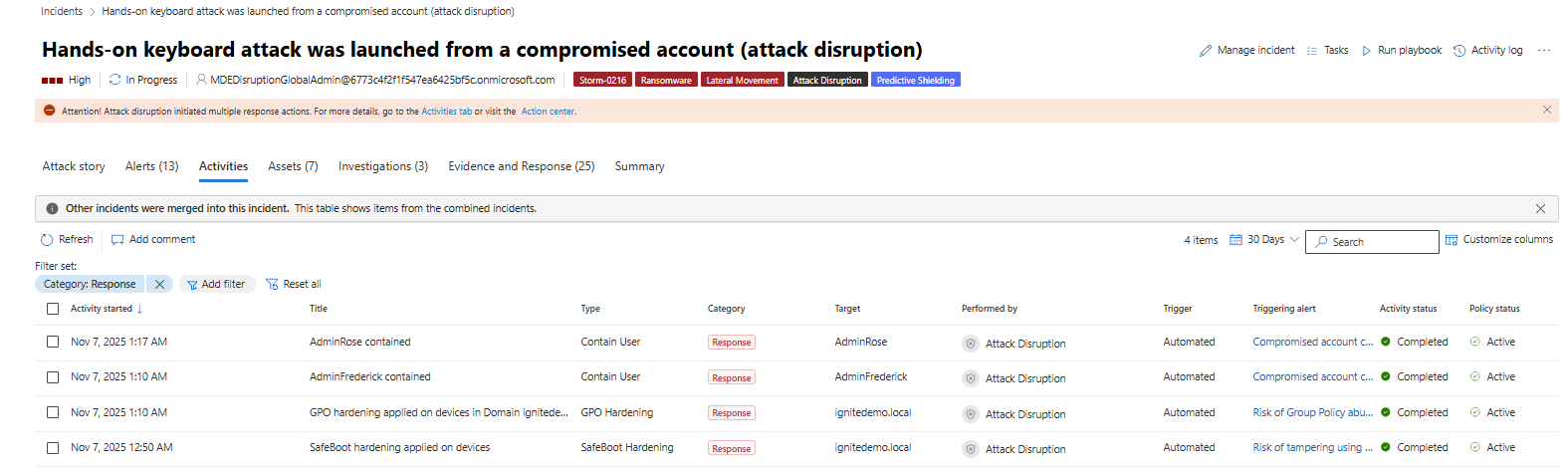
Click Triggering alert to access alert details that initiated the action. Monitor Policy status to see currently active hardening policies.
Select any action to view the activity details pane, which describes the action and lists affected devices.
The Performed by column shows Attack Disruption for both attack disruption and predictive shielding.
Conclusion
Predictive Shielding represents Microsoft's bold leap from reactive defense to proactive prediction. By combining threat intelligence, exposure graphs, and precision enforcement, it delivers surgical protection with less business disruption.
Contact our expert at Precio Fishbone for tailored business solutions and early access guidance.
Share this on

Jerry Johansson
Works in IT and digital services, turning complex ideas into clear, engaging messages — and giving simple ideas the impact they deserve. With a background in journalism, Jerry connects technology and people through strategic communication, data-driven marketing, and well-crafted content. Driven by curiosity, clarity, and a strong cup of coffee.