
Understanding Prompt Flow in Azure AI Foundry
Prompt Flow is a flow-based orchestration system designed to manage AI prompts, retrieval processes, and response generation step by step. It allows organisations to visualise the movement of data between components and provides a centralised workspace to customise, debug, and monitor AI workflows. Unlike standard prompt execution, Prompt Flow separates tasks such as querying a vector index, injecting retrieved content into prompts, and invoking a language model, enabling precise control over the AI response.
In Prompt Flow, a flow functions as an executable workflow that organises and automates each stage of an LLM-based application. It is built from nodes, which act as modular tools responsible for handling specific tasks such as data processing or model execution. These nodes are connected to form a continuous data pipeline. The entire structure is visualised as a Directed Acyclic Graph (DAG), allowing developers to clearly see how data moves and how each component depends on others, making configuration and optimisation more intuitive.
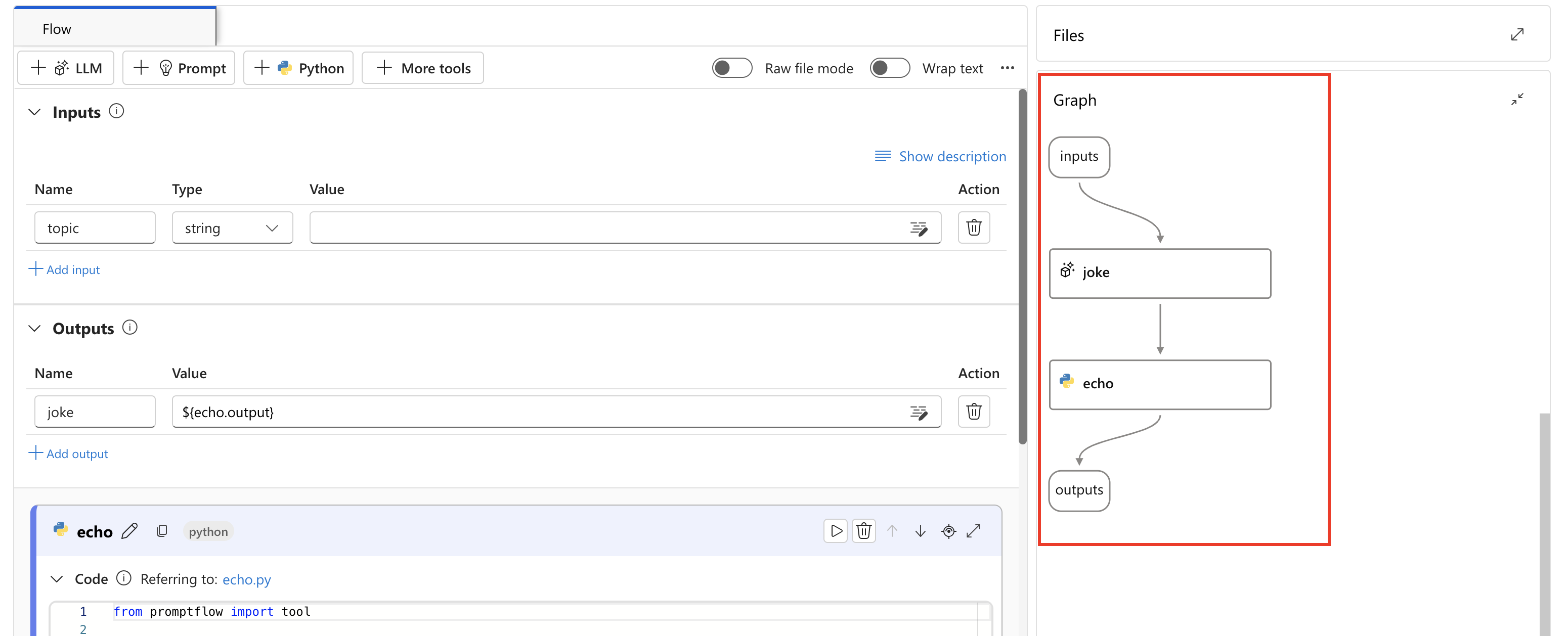
For businesses relying on internal documentation, this orchestration is critical. Documents uploaded to Azure AI Foundry are first split into smaller segments and embedded into vectors. These vectors are stored in an AI Search index, allowing similarity-based retrieval. When a query is received, Prompt Flow coordinates the retrieval of relevant document chunks and their injection into the prompt template for the language model.
Setting Up AI Search and Index for RAG
Before using Prompt Flow, businesses need a properly configured AI Search service. Each uploaded document is chunked into smaller units, which are then converted into vector embeddings. These embeddings represent the semantic content of the documents and are stored in a vector index. When a user's query is received, the query is similarly embedded and compared against the index to find the most relevant chunks.
In Azure AI Foundry, creating the index involves navigating to the “Data & Indexes” section, uploading files directly to the Foundry storage, and selecting “New Index” with “Data in Azure AI Foundry” as the source. The AI Search service then embeds these documents and provides a similarity search interface for Prompt Flow. This setup ensures that the language model has access to current and project-specific knowledge during generation.
Orchestrating RAG Workflows with Prompt Flow
Once the AI Search index is ready, Azure Prompt Flow can be used to orchestrate the workflow. A standard flow involves three main nodes: the input query, the index lookup, and the language model.
This setup ensures that only the textual content of relevant chunks is passed to the language model. The LLM node then receives both the user's query and the retrieved text, generating a contextually informed response. The output is returned directly to the user, completing the RAG workflow.
Prompt Flow also allows the integration of multiple tools, flexible flow paths, and external APIs if needed, making it highly adaptable to varied document types and organisational needs.
Evaluating RAG with Azure AI Prompt Flow
Evaluating a RAG system is a crucial step to ensure that the model generates accurate and contextually relevant answers. Within Azure AI Prompt Flow, evaluation is built directly into the development environment, allowing teams to systematically test and refine how their RAG pipelines perform in real-world scenarios.
Prompt Flow provides an interactive evaluation workspace where every component of a RAG workflow, from vector retrieval to language model output, can be monitored, compared, and improved. Instead of viewing only the final answer, teams can trace the full reasoning chain, including how a query triggers document retrieval, how retrieved chunks are injected into prompts, and how the language model generates the final response.
When evaluating a RAG pipeline, Prompt Flow allows developers to run evaluation nodes that capture intermediate outputs and analyse their relevance and quality. These evaluations typically focus on two key areas:
- Automated evaluation: The system automatically scores model outputs using predefined metrics such as semantic similarity or keyword overlap between generated answers and reference responses.
- Manual evaluation: Reviewers assign scores or qualitative feedback to assess aspects such as tone, coherence, and domain-specific accuracy.
Ready to Build Smarter AI Solutions?
Integrating Prompt Flow and Azure AI Search is just the beginning of creating intelligent, context-aware applications. Precio Fishbone helps organisations unlock the full potential of Azure OpenAI and ensure their RAG solutions are optimised for real business needs by combining deep technical expertise with strong business understanding.
Connect with professional consultants to explore how Azure AI Foundry and enterprise-grade AI orchestration can transform your data into actionable intelligence.
Share this on

Jerry Johansson
Works in IT and digital services, turning complex ideas into clear, engaging messages — and giving simple ideas the impact they deserve. With a background in journalism, Jerry connects technology and people through strategic communication, data-driven marketing, and well-crafted content. Driven by curiosity, clarity, and a strong cup of coffee.