
AI investment is clearly gaining momentum across Europe and the Middle East. Deloitte’s 2025 survey of more than 1,800 executives shows that Nordic firms are among those leaning-in most actively, with around 70% allocating at least 10% of their IT budget to AI and more than half increasing AI spending by over 10% last year.
Yet higher spending has not translated into fast returns. Most organizations report that a typical AI use case takes two to four years to deliver satisfactory value. Only a small minority achieves payback in under a year.
Why is the ROI of AI investment hard to achieve? What really separates the companies that succeed from those that fall behind, and what can you do to take the next step?
Nordic Spending More to AI
Nordic organizations continue to show strong confidence in AI (see fig.). More than half of respondents (55%) had already raised AI spending by over 10% in the past year, and the outlook remains equally positive: 68% expect their AI budgets to increase by more than 10% over the next 12 months. This suggests that, despite ongoing questions around payback, companies in the region are still willing to continue expanding AI investment.
Looking ahead to the next 12 months (to August 2026), what is your organization's plan for its financial investment in AI?
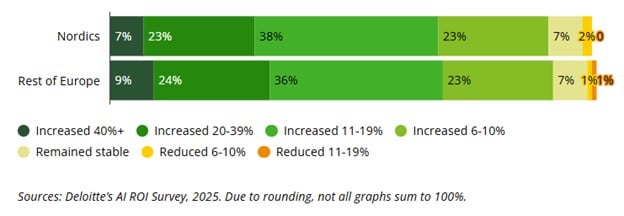
Sources: Deloitte’s AI ROI Survey, 2025. Due to rounding, not all graphs sum to 100%.
Key drivers behind the rise in investment include “more use cases have been identified across the organization,” “increased internal capacity from improved data or data infrastructure,” and “response to strong ROI from past investments in AI.”
Rising Investment, Lagging ROI
Yet despite this momentum, most respondents reported achieving satisfactory ROI on a typical AI use case within two to four years. This is significantly longer than the typical payback period of seven to 12 months expected for technology investments.
Only six per cent reported payback in under a year, and even among the most successful projects, just 13 per cent saw returns within 12 months.
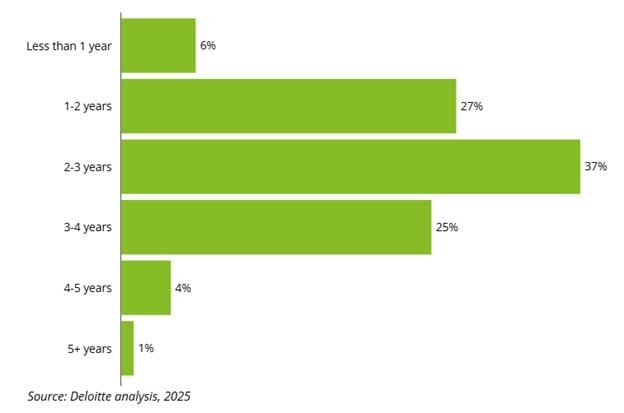
Sources: Deloitte analysis, 2025
According to the executives interviewed as part of this research, AI rarely delivers value in isolation. It is typically introduced alongside efforts to improve data quality, reconfigure teams or streamline operations, which makes it difficult to isolate its value.
"The timeline for realising AI gains varies across business sectors, but on average, significant benefits take several years to materialise."
Executive, Consumer Goods Company
The challenge becomes even more pronounced with agentic AI. These systems promise end-to-end process automation and autonomous decision-making, but they also come with greater complexity and longer implementation timelines. Among organizations already using agentic AI, most expect it to take three to five years to see meaningful ROI.
Why AI ROI Is Hard to Achieve
Achieving strong AI ROI is rarely straightforward. For many organizations, returns take time because AI value depends not only on the technology itself, but also on data readiness, adoption and integration across the business. Here are five key reasons why ROI is often difficult to realize.
1. Many AI benefits are hard to measure
AI often creates value in ways that do not immediately show up in financial metrics. Better customer experience, stronger employee productivity and improved decision-making all matter, but they can be difficult to quantify in the early stages.
2. Poor data foundations slow results
Siloed systems, fragmented platforms and inconsistent data quality make it harder to measure impact and scale use cases. Many organizations move into AI too early, before fixing core data and infrastructure issues, which delays ROI.
3. AI is evolving faster than business metrics
The AI landscape changes quickly. New tools, models and use cases continue to reshape expectations, often before organizations have defined the right success metrics. This can lead to premature investment and unclear benchmarks for value.
4. Adoption depends on people, not just technology
Even the best AI solution will struggle without user adoption. Cultural resistance, lack of training and limited workflow integration can all reduce impact and slow the path to measurable returns.
5. AI is part of a bigger transformation
AI is rarely implemented on its own. It is usually introduced alongside wider digital, operational or organizational change, making it difficult to isolate AI’s direct contribution to business performance.
What Successful Organizations Do Differently
To better understand what separates high-performing companies from the rest, an AI ROI Performance Index was created using four business measures: direct financial return, AI-driven revenue growth, operational cost savings and speed to value. Based on the combined score, the top 20% of organizations were identified as AI ROI Leaders.
What sets these leaders apart is not simply a higher level of AI adoption, but a more strategic approach to value creation. AI is treated as an enterprise-wide transformation, supported by stronger ROI discipline and earlier investment in both generative and agentic AI. The five practices below stand out most clearly.
Rethink and reimagine
AI ROI Leaders are more likely to link AI with growth and reinvention, not just efficiency. Nearly half cite revenue growth opportunities (49%) as their most important AI win, while 45% point to rethinking the business model.
Differentiate investment
A stronger return on AI is closely tied to stronger financial commitment. Ninety-five per cent of AI ROI Leaders allocate more than 10% of their technology budget to AI. They are also more likely than other organizations to have significantly increased AI spending over the past 12 months, and more likely to continue increasing that investment over the next year.
Take a human-centered approach
Adoption remains critical to AI success. Among AI ROI Leaders, 83% believe agentic AI will free employees to focus more on strategic and creative work. This reflects the importance of change management, leadership support and a culture that encourages adoption.
Measure ROI differently
Leading organizations are also more sophisticated in how they define and evaluate success. Eighty-five per cent of AI ROI Leaders explicitly use different frameworks or time horizons for generative AI and agentic AI. Rather than applying a one-size-fits-all approach, they recognize that different AI models create value in different ways and over different timelines.
Mandate AI fluency
AI fluency is increasingly being treated as a core business capability. Among AI ROI Leaders, 40% make AI training mandatory. This reflects a shift away from optional learning and towards embedding AI understanding across the workforce. As adoption expands, structured capability-building becomes essential to scaling value and improving decision-making across the organization.
Finding the right AI partner is essential to achieving AI ROI
Achieving AI ROI is not only about choosing the right use cases or investing in the right technology. It also depends on choosing the right partner. As AI moves from experimentation to enterprise transformation, businesses need solutions that fit their processes, connect with existing systems and remain flexible as needs evolve.
"Moving to an agentic platform is a true game changer. But it requires seamless interaction with the entire ecosystem, including data, tools and business processes.”
Executive, Financial Services Company
That is exactly why the right AI partner matters: success depends not just on the model, but on how well AI works in day-to-day operations.
At Precio Fishbone, we build AI solutions designed for long-term business value:
- Perfect adaptation to your processes – the system follows your business, not the other way around
- Easy integration – connects seamlessly to your existing systems
- Full control – you own the code and can further develop as needed
- Scalability – grows with your business without limits
With the right partner, AI becomes easier to adopt, easier to scale and far more likely to deliver measurable ROI.
Share this on

Jerry Johansson
Works in IT and digital services, turning complex ideas into clear, engaging messages — and giving simple ideas the impact they deserve. With a background in journalism, Jerry connects technology and people through strategic communication, data-driven marketing, and well-crafted content. Driven by curiosity, clarity, and a strong cup of coffee.