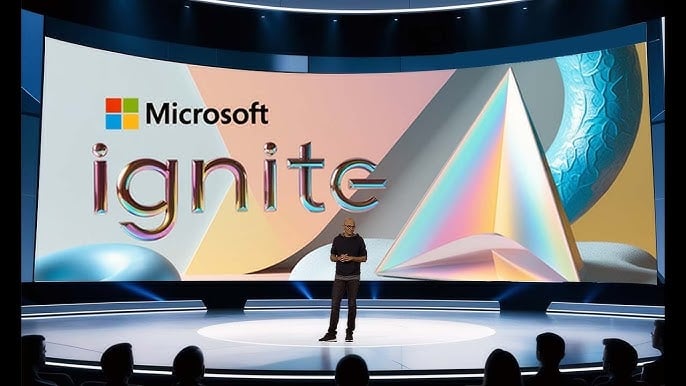
Opening: Ignite 2025 Signals a New Copilot Era
Ignite 2025 made it clear positioning Copilot as “a smart assistant in your apps” and started presenting it as a full agentic platform for the enterprise. The keynote message was simple but ambitious. Work is moving from prompting AI to delegating work to AI, and Microsoft wants to provide the entire stack needed to make that safe, scalable, and useful.
To support this shift, Microsoft announced four tightly connected building blocks. First, Microsoft Foundry, the new name and expanded scope of Azure AI Foundry, becomes the cloud factory where organizations build and operate production-grade agents.
Second, a new family of IQ products (Work IQ, Fabric IQ, Foundry IQ) provide the contextual intelligence that makes Copilot agents more reliable than generic “connector-based” bots.
Third, Agent 365 arrives as a control plane in the Microsoft 365 admin center, treating agents like identities with the same governance, security, and compliance controls as human users.
Finally, Agent Factory is Microsoft’s adoption program to help enterprises industrialize agent development and scale faster with bundled access and engineering support.
Security was not a footnote. Ignite 2025 pushed Copilot security forward with practical moves like including Security Copilot in Microsoft 365 E5 and introducing Baseline Security Mode.
Together, these announcements define the new Copilot era: agents powered by deep context, built on Foundry, and governed through Agent 365.
The Copilot Shift in 2025: From “Prompting” to “Delegating Work”
If you track Copilot’s evolution across the last two years, Ignite 2025 is the clearest line in the sand. Earlier Copilot experiences were largely prompt driven. You asked, Copilot answered. The new direction is delegation. You describe the outcome, and agents plan, act, and report back, often across multiple tools and systems.
Microsoft tied this to the “Frontier Firm” idea: organizations that blend human teams with an AI workforce, where agents handle routine and multi-step tasks under clear accountability.
The reason this matters is not philosophical. It is operational. As more teams create agents in Copilot Studio or via Azure, enterprises face two immediate risks: inconsistent context that makes agents unreliable, and agent sprawl that creates shadow IT.
Ignite’s stack is meant to solve both at once. Context comes from the IQ products. Governance comes from Agent 365. Build and runtime comes from Foundry. Acceleration comes from Agent Factory. For a closer look at how this shows up in day-to-day tools such as Word, Excel, PowerPoint and SharePoint, read our guide to the latest Microsoft 365 Copilot agent updates.
Microsoft Foundry: The Enterprise Platform Behind Copilot Agents
Microsoft Foundry is the cloud layer where agentic Copilot becomes more than a demo. At Ignite, Microsoft rebranded Azure AI Foundry to “Microsoft Foundry” and expanded the platform into an end-to-end environment for building, operating, and governing enterprise AI agents at scale.
Several Foundry updates are particularly important for Copilot strategies:
MCP Catalog and prebuilt connectors
Foundry introduced a Model Context Protocol (MCP) Catalog with a large set of prebuilt connectors, drawing from Logic Apps integrations. Practically, this is a safer and more standardized way to let agents take actions through enterprise APIs. Instead of each team wiring tools ad hoc, MCP provides a managed integration surface aligned to governance.
Model Router is now generally available
Foundry’s Model Router automatically selects the best model for a given task, balancing accuracy, latency, and cost. This is a quiet but huge capability for enterprises operating multiple models across scenarios. It also supports the latest GPT families and other foundation models as they arrive.
Foundry Agent Service (preview)
Agent Service provides a hosted runtime for long-lived agents, with features like persistent memory and multi-agent orchestration. In other words, Foundry is not just for building a bot, but for running a reliable agent workforce that can handle multi-step goals over time.
Foundry Control Plane (preview)
Control Plane adds production operations to agents. Teams can trace behavior, monitor performance, enforce guardrails, and connect governance through Entra identities plus Defender and Purview. This makes AI operations look more like modern cloud operations, rather than a collection of scripts.
Foundry matters to Copilot users because it is where the “beyond Microsoft 365” cases live. If your Copilot needs to automate processes across line-of-business platforms, or you need specialized retrieval and reasoning, Foundry is the platform layer that turns that into a governed, repeatable build path.
The IQ Products: Context Layers That Make Copilot Agents Trustworthy
Microsoft used Ignite 2025 to admit something many enterprises have felt. AI power alone is not enough. Without deep organizational context, agents either stay shallow or drift into hallucinations.
The keynote highlighted that Copilot’s value comes from contextual relevance, and Work IQ is the starting point for rebuilding that relevance engine. Ignite introduced three IQ products designed to solve the context problem end-to-end.
Work IQ: collaboration context for Copilot
Work IQ sits behind Microsoft 365 Copilot and Copilot Chat. It learns from your daily work signals: files you open, who you collaborate with, meeting patterns, mail threads, and active projects. The goal is to let Copilot and agents understand what matters to your role and what you are trying to get done, not just what you type into a prompt. Microsoft also noted that Work IQ will expose APIs, so developers can build custom agents that inherit the same work awareness.
Fabric IQ: data and business meaning context
Fabric IQ extends the same approach into analytics and operational data inside Microsoft Fabric. It uses semantic models (for example Power BI models) so AI can reason over business meaning, not just rows and columns. This is still in preview, but it closes a major gap for organizations that want agents to work over real metrics with correct interpretation.
Foundry IQ: retrieval context across sources
Foundry IQ provides a managed retrieval layer inside Foundry. It indexes multiple sources, including Work IQ, Fabric IQ, web data, and custom systems, so agents can ground on trusted enterprise knowledge without teams rebuilding RAG pipelines from scratch. Like Fabric IQ, it is in preview, but the architecture is clear: a single retrieval fabric for all agents.
Taken together, the IQ products explain why Microsoft is leaning hard into agents. Agents become truly useful only when they can see the same context your people work in, and reason over it safely.
Agent 365: Governance and Observability for the AI Workforce
If Foundry is the factory floor, Agent 365 is the control tower. Agent 365 was introduced as the control plane for deploying, managing, and governing agents across Microsoft 365, Azure, Windows, and even third-party agent ecosystems.
The key design choice is that Microsoft is not treating agents as a special-case tool. Agents are being treated as identities.
Entra Agent ID
Every agent gets its own Entra Agent ID. That means role-based access control, Conditional Access, auditing, and data loss prevention can be enforced the same way they are for human users. This is the direct answer to shadow AI. If an agent can access your tenant, it must be discoverable and governable.
Agent registry and lifecycle controls
Agent 365 includes a registry, essentially a directory of all agents operating in the tenant. IT can see what exists, what sources each agent touches, and what capabilities it can perform. The keynote framed this as the first sustainable approach to managing an “AI workforce” over the long term.
Cross-platform governance
Microsoft stressed that Agent 365 applies across Copilot Studio, Foundry, and other agent entry points. This is important because agent growth will not stay confined to one tool. Agent 365 is meant to be the single pane of glass across the Microsoft stack.
Right now, Agent 365 is available for Frontier program customers, but the direction is obvious. As agents become mainstream, governance must be mainstream too.
Agent Factory: Microsoft’s program for Rapid, Governed Agent Scale
Agent Factory is not a product feature. It is Microsoft’s enterprise adoption motion for agents, and it matters if you are serious about scaling beyond pilots.
The program bundles access to the IQ platforms through Microsoft Foundry and Copilot Studio, under a single metered plan. For approved customers, licensing complexity is reduced so teams can build and deploy agents broadly, including inside Microsoft 365 Copilot experiences, without constant SKU negotiation. Microsoft also pairs customers with forward-deployed engineering support and training to improve AI fluency across teams.
Why this is strategically significant: Microsoft is acknowledging that building agents is not just a tooling problem. It is an organizational change problem. Agent Factory is their attempt to shorten time-to-value by combining platform access with hands-on implementation support.
Copilot Security Updates: Designing for the Agentic Attack Surface
Ignite 2025 treated security as a prerequisite for agentic work, not an optional add-on. Microsoft’s view is that as agents proliferate, the enterprise attack surface expands. Unseen autonomous scripts with data access are risky if not governed.
Two security moves stood out:
Security Copilot is now included in Microsoft 365 E5
Microsoft made Security Copilot available at no extra cost for Microsoft 365 E5 and E5 Security customers. Until now, clients often treated Security Copilot as a separate investment. Bundling it into E5 signals that AI-driven defense is now part of the baseline platform.
Baseline Security Mode
Baseline Security Mode enforces secure-by-default tenant settings through a guided experience. Think mandatory MFA, blocking legacy authentication, and other hygiene controls turned on consistently. It was introduced as a way to reduce uneven security postures, especially as Copilot and agents make identity and data controls more important.
These updates connect tightly to Agent 365. When agents have Entra identities and are visible in a registry, security teams can apply Defender and Purview controls across both humans and AI workers. That is what Microsoft called the foundation for “ambient security” in the agent era.
Multi-Model Copilot on Azure: Claude Joins the Stack
Ignite also expanded the model ecosystem inside Azure. Microsoft, Anthropic, and NVIDIA announced a major partnership that brings Claude models to Azure and positions them as first-class citizens alongside GPT families.
For Copilot and Foundry users, this matters less as “model news” and more as an architecture signal. Microsoft expects enterprises to run multi-model stacks, choosing models by task, safety profile, latency, and cost. Foundry’s Model Router is built for exactly this reality, and Ignite showed the early shape of a truly model-agnostic agent platform.
What to Watch Next
Ignite 2025 did not just announce features. It made Copilot’s trajectory easier to read. Expect three things over the next year.
First, Agent 365 will broaden beyond Frontier and become the core admin surface for all agentic workloads, including third-party agents. The governance problem is only going to grow, and Microsoft is clearly building for that future.
Second, the IQ layers will mature and spread across Copilot surfaces. Work IQ is already positioned as the relevancy engine for Copilot, while Fabric IQ and Foundry IQ bring the same principle into analytics and retrieval. As those previews land, Copilot agents should become more predictable and more business-aware.
Third, Foundry will be where advanced Copilot extensions concentrate, particularly in regulated industries and public sector scenarios where custom grounding, private networking, and strict observability are non-negotiable.
Conclusion: Ignite 2025 Made Copilot a Real Agent Platform
Ignite 2025 is best understood as the launch of Copilot’s agent stack. Microsoft Foundry provides the build and runtime platform. IQ products provide contextual intelligence. Agent 365 provides governance and security through identity. Agent Factory provides an accelerated path to scale.
For enterprise leaders, the takeaway is practical. Copilot is no longer just a productivity feature. It is a managed digital workforce strategy, with the tooling to build, run, and govern agents as confidently as any other enterprise workload. Contact us to get a tailored Copilot agent-stack readiness assessment and a step-by-step rollout plan for your organization.
Share this on

Jerry Johansson
Works in IT and digital services, turning complex ideas into clear, engaging messages — and giving simple ideas the impact they deserve. With a background in journalism, Jerry connects technology and people through strategic communication, data-driven marketing, and well-crafted content. Driven by curiosity, clarity, and a strong cup of coffee.