
The OpenAI Decisions API lets software ask GPT-6 Luna a fixed question and get back a probability, a choice or a score instead of text. OpenAI released it in beta on October 6, 2026, and made it generally available on October 22. Microsoft published documentation for the same API on Azure on October 21, so teams on Azure no longer have to go to OpenAI directly to use it.
- Should we call OpenAI directly or go through Azure? See which agreement covers your data on each route.
- Do we need GPT-6 Luna at all? Compare it with Microsoft Decision 1 and Jev on input, price and data location.
Short answer: If you already run AI on Azure, call the Decisions API through your Azure OpenAI deployment, and go to OpenAI directly only once a signed agreement covers retention and region. For text-only decisions, test Microsoft Decision 1 as well, because its input price is less than half of Luna's.
What Is the OpenAI Decisions API?
The OpenAI Decisions API is an endpoint that takes text or images plus questions with fixed answers, and returns typed answers your software can act on at once. According to OpenAI's Decisions guide, it supports only GPT-6 Luna and three question types:
| Question type | Example | Answer |
| Predicate | Is this product photo damaged? | Probability from 0 to 1 |
| Choice | Which department handles this complaint? | A probability for each option, plus a confidence value |
| Score | How severe is this incident? | A probability for each level, plus a confidence value |
OpenAI charges $0.10 per million uncached input tokens and nothing for output tokens. A decision of 500 input tokens, roughly a long email plus its question, costs $50 per million calls. Since general availability, one request can carry up to 400 questions, pass structured data as JSON and include images. OpenAI says the endpoint returns typed answers about 10 times faster than its Responses API. The confidence value lets software act on the sure cases and send the unsure ones to a person.
Can You Use the Decisions API on Azure?
Yes. Microsoft's Decisions API documentation describes the endpoint on Azure at /openai/v1/decisions, with GPT-6 Luna as the only supported model. A request carries the model, the input and the questions, using the same predicate, choice and score types, and choice and score answers return a confidence value as they do on OpenAI. Each request takes up to 400 questions and 128 images, with a combined image size of 32 MB.
The Azure version is still rolling out to the regions where GPT-6 Luna runs, and East US 2 is excluded. Microsoft's page does not say which deployment types serve decision calls, so ask whether a Data Zone deployment can before you plan EU workloads on it. The page also points to the general Azure OpenAI price list, which has no separate line for decision calls. Measure the cost on real calls before you assume output is free on Azure as it is on OpenAI.
Should You Call OpenAI Directly or Through Azure?
Call it through Azure if your company already runs AI there, because the call then stays under the Microsoft agreement you already have. Microsoft's data privacy page for Foundry models states that your prompts and completions are not available to OpenAI and are not used to train models without your permission. When abuse monitoring detects signs of misuse, Azure can store a sample of prompts and completions for human review, unless Microsoft has approved you for modified abuse monitoring, as covered in Azure OpenAI abuse monitoring.
Going direct makes OpenAI a new data processor, with its own agreement, keys, invoice and audit trail. OpenAI does not train on Decisions API data either. Its data controls page says abuse monitoring logs for this endpoint are kept for up to 30 days by default, and Zero Data Retention is open to eligible customers only. To process in Europe, you need OpenAI's approval for abuse monitoring controls and a Modified Retention amendment, and you pay 10% more. A team that goes direct without approval has created shadow AI.
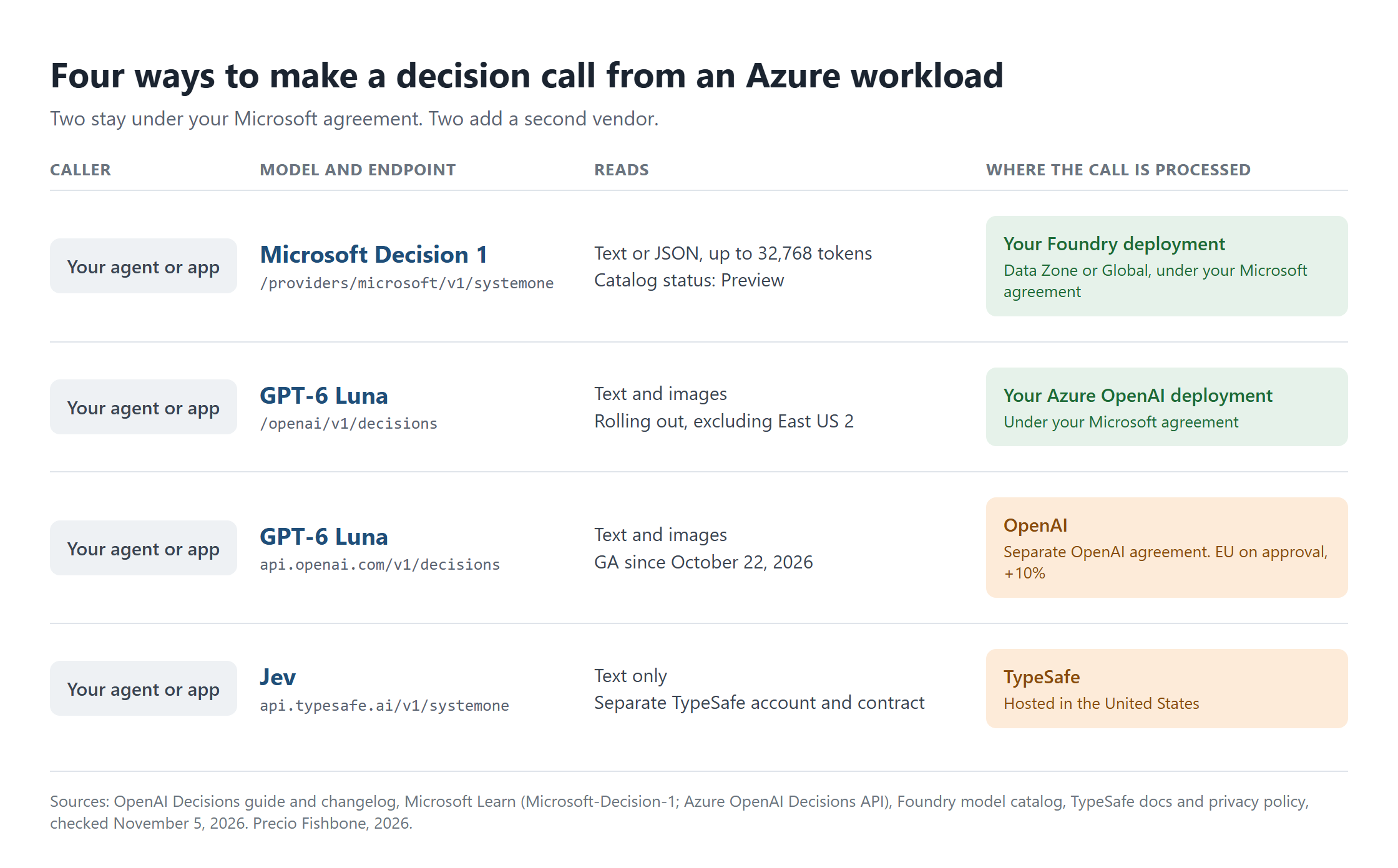
Figure 1. Microsoft Decision 1 and the Azure Decisions API keep the call under your Microsoft agreement. OpenAI direct and Jev add a second vendor.
Decisions API, Microsoft Decision 1 or Jev?
Use the Decisions API when a decision depends on an image, and test Microsoft Decision 1 for high-volume text decisions. Decision 1 is Microsoft's own decision model in Foundry, and Jev is the decision model from TypeSafe.
| Decisions API, GPT-6 Luna | Microsoft Decision 1 | Jev | |
| Input | Text and images | Text or JSON | Text only |
| Input price per 1M tokens | $0.10 on OpenAI | $0.042 | $0.042 |
| Confidence value | Choice and score | Not documented | Choice |
| Where the call runs | Azure deployment or OpenAI | Your Foundry deployment | United States |
The Foundry model catalog lists Microsoft Decision 1 as Preview, with text input, JSON output and a context window of 32,768 tokens. Microsoft's launch announcement prices it at $0.042 per million input tokens with free output, the same as Jev. A million decisions of 500 input tokens cost $21 on either, against $50 on OpenAI direct. Its request format follows Jev's and differs from the Decisions API, so moving between Luna and Decision 1 means rewriting the request. Microsoft Decision 1 covers its data zones and the move from Jev.
I would keep Jev for text with no personal data in it, where price is the only thing at stake. Every Jev call goes to the United States, which raises the questions in Jev GDPR.
How Do You Start a First Decision on Azure?
Start with one decision you can check against past answers, and run it on Azure before anyone signs a second agreement.
- Pick one repeated decision that already has correct answers on file, such as last quarter's routed support tickets.
- Keep the model call in one place in the code, so switching between Luna and Decision 1 later changes one place.
- Run the past cases through the Azure Decisions API and, for text-only decisions, through Microsoft Decision 1, then count the wrong answers on each.
- Set your cut-offs from those labeled results. OpenAI's guide recommends labeled examples from your own application, and a cut-off tuned on one model can pass a different share of cases on another.
Where the model returns a confidence value, send the unsure cases to a person from the first day. Store each score next to the final outcome, so you can explain a decision later and retune the cut-offs.
Work with Precio Fishbone
Your developers can use the OpenAI Decisions API without adding a second vendor, because it now runs on Azure under your Microsoft agreement. The open questions are which decision to automate first and who controls access and data around it. If you want help with either, talk to our AI services team, or email me at par.johansson@preciofishbone.se.
Frequently Asked Questions
Is the OpenAI Decisions API available on Azure?
Yes. Microsoft documents it at /openai/v1/decisions with GPT-6 Luna. As of November 5, 2026, it is rolling out to the regions where Luna runs, excluding East US 2.
How much does the OpenAI Decisions API cost?
On OpenAI, $0.10 per million uncached input tokens, with no charge for output tokens. Regional data residency endpoints add a 10% uplift. Microsoft's Decisions API page refers to the general Azure OpenAI price list, which has no separate line for decision calls.
Is the OpenAI Decisions API generally available?
Yes, on OpenAI's platform since October 22, 2026, after a public beta that started on October 6.
Is the OpenAI Decisions API the same as Jev?
No. Both return typed answers instead of text, but Jev is a separate model from TypeSafe. Jev reads text only and costs $0.042 per million input tokens. The Decisions API runs GPT-6 Luna and also reads images.
Share this on

Pär Johansson
Pär works with international business at Precio Fishbone, project delivery & digital services, helping turn complexity into progress and strategy into long-term value. With many years of experience in international business, He is known for building strong relationships and turning plans into meaningful progress. Driven by people, trust and sustainable growth.