Picture a finance director holding two price sheets for the GPT-6 Astra vs Claude Fable 5.1 decision. Both list $10 per million input tokens and $50 per million output tokens. The obvious question is which one is cheaper, and the honest answer is that the price sheet cannot tell you.
This enterprise AI model comparison uses vendor documentation and Artificial Analysis, an independent evaluator, as read on 1 October 2026. It covers where each model runs in Microsoft Foundry and what that means for European organisations that must answer to a data protection officer.
A note on perspective: this post takes a Microsoft ecosystem view. Anthropic's documentation also lists Fable 5.1 on Amazon Bedrock and Google Cloud, which we have not assessed. Neither model wins everywhere.
GPT-6 Astra vs Claude Fable 5.1: why identical list prices produce different bills
Three things separate the two bills. Our piece on the real cost of model calls that only make a decision in Foundry covers why cost per call misleads.
| USD per million tokens | GPT-6 Astra | Claude Fable 5.1 |
| Input | $10.00 | $10.00 |
| Output | $50.00 | $50.00 |
| Cache read | $1.00 | $0.25 |
| Prompts above 272,000 input tokens | $20 input, $2 cache, $75 output, for the full request | Full 1M token window at standard pricing |
Sources: OpenAI model page for GPT-6 Astra and Anthropic pricing page
The first is caching. An agent that resends the same instructions and documents every turn feels the gap quickly, because Fable 5.1 charges a quarter of Astra's cache read rate.
The second is long prompts. OpenAI's documentation prices any Astra request above 272,000 input tokens at higher rates for the full request. Anthropic includes the full 1M token window at standard pricing. Archive scale requests therefore favour Fable 5.1.
The third is how many tokens each model spends to finish a job. At maximum effort, Artificial Analysis measures Astra at about a third of Fable 5.1's output tokens, and its cost per task follows.
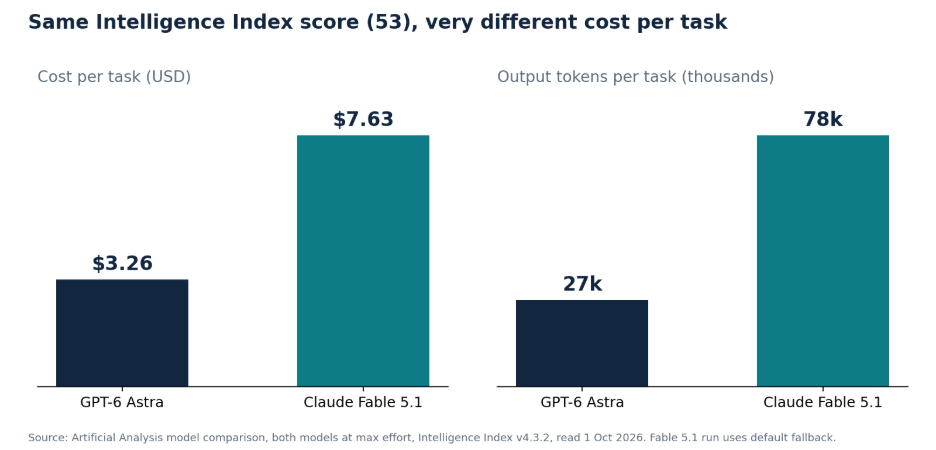
Figure 1. Source: Artificial Analysis model comparison, max effort, Intelligence Index v4.3.2.
That is the gap the price sheet hides. Treat it as a signal to test, not a forecast of your bill.
AI cost per task: a worked example for your finance team
This example is illustrative and uses list rates only, ignoring cache writes. Take 300 report requests a month. Each reads 40,000 cached tokens, adds 2,000 fresh input tokens and produces 1,500 output tokens.
Figure 2. Calculated by Precio Fishbone from the list rates above. Scenario 2 applies Artificial Analysis's output token ratio of about 2.9.
At equal output, the whole difference is the cached reads, and Fable 5.1 stays cheaper only while it writes less than about 1.4 times what Astra writes. Apply Artificial Analysis's token ratio and the answer flips. One 400,000 token request flips it back.
AI cost per task depends on your ratio of cached reads to fresh output, not on the rate card. Run the same arithmetic on your own volumes.
Enterprise AI model comparison: what the independent evidence shows
Lower cost per task is not better output. On Artificial Analysis's Intelligence Index v4.3.2 the two tie at maximum effort. Earlier index versions ranked Fable 5.1 ahead, so check which version a source quotes.
| Evaluation | GPT-6 Astra | Claude Fable 5.1 | Leads |
| Intelligence Index | 53 | 53 | Tie |
| AA-Briefcase (Elo) | 1569 | 1678 | Fable 5.1 |
| GDPval-AA (Elo) | 1542 | 1735 | Fable 5.1 |
| SciCode | 56% | 63% | Fable 5.1 |
| Humanity's Last Exam | 55% | 59% | Fable 5.1 |
| AA-LCR (long context) | 81% | 85% | Fable 5.1 |
| AutomationBench-AA | 68% | 59% | Astra |
| Terminal-Bench 4.0 | 59% | 52% | Astra |
| GDP.pdf | 31% | 26% | Astra |
| CritPt | 32% | 30% | Astra |
| AA-Omniscience | 43 | 43 | Tie |
Source: Artificial Analysis model comparison, Astra at max effort against Fable 5.1 at max effort with default fallback
Both runs use maximum effort. Artificial Analysis also tested Fable 5.1 with Anthropic's default fallback switched on. That setting reroutes requests flagged by Fable 5.1's cybersecurity and biology safeguards to a less capable Opus model, so its scores describe Fable 5.1 plus that fallback. SciCode and CritPt are marked under review.
The practical reading is a split. Fable 5.1 looks stronger on knowledge work and long documents, and Astra on workflow automation at a lower cost per task. Test on your own contracts, reports and customer emails rather than a leaderboard.
Microsoft Foundry: where each model runs and what it means for Europe
Both models can be evaluated in Microsoft Foundry under one Azure tenant, although Claude models need an Azure Marketplace subscription.
| GPT-6 Astra | Claude Fable 5.1 | |
| Hosting | Microsoft Azure environment | Anthropic infrastructure |
| Foundry deployment types | Standard in Global and US and EU Data Zones, plus Provisioned Throughput | Global Standard only |
| Billing | Azure | Claude Consumption Units through Azure Marketplace |
| Data processor | Microsoft | Anthropic |
| Copilot Cowork and Copilot Studio | Rolling out | Rolling out from 1 September 2026, with Anthropic as a Microsoft subprocessor |
Sources: Anthropic, "Claude in Microsoft Foundry"; Microsoft Azure blog, 22 September 2026; Microsoft Message Center MC1465748.
If EU processing is a requirement for Foundry deployments, that difference matters more than any benchmark. Claude on Foundry offers Global and US Data Zone Standard, but Fable 5.1 is hosted by Anthropic and so is limited to Global Standard.
Retention needs the same care. Anthropic states that Fable 5.1 requires 30 day retention, including in Foundry, where Anthropic is the data processor. Zero data retention needs Anthropic's express authorisation, which eligible enterprises can use while Enterprise Frontier Safeguards roll out.
For Astra, Microsoft's data privacy page for models sold by Azure says prompts and completions are not used to train the base models, and it also describes abuse monitoring. We did not verify Astra specific retention terms, so ask your data protection officer to review both positions. Our review of Azure OpenAI security, privacy and BCDR is a useful start.
Copilot Studio and Copilot Cowork: both models reach business users
Microsoft has added both models to Copilot Cowork and Copilot Studio, and its Message Center places the Fable 5.1 rollout from 1 September 2026. The idea is delegation: hand over larger tasks, then review results. For Astra, Microsoft says Work IQ grounds the model in your files, meetings and chats within existing permissions.
Data handling differs here. Fable 5.1 runs with Anthropic as a Microsoft subprocessor, and only where an admin has enabled Anthropic models in the Microsoft 365 admin center. Microsoft states that Anthropic does not retain prompts or outputs in that use. Copilot Studio can need a second check in the Power Platform admin center, and rollout varies by tenant.
If you are deciding where to build, read Copilot vs Copilot Studio. For permissions and agent controls, see Work IQ in Microsoft 365 Copilot and Agent 365 as a control plane.
From GPT-6 Astra vs Claude Fable 5.1 to a working decision
Choosing between two models is only half the decision. The other half is where you run them and how you divide work between tiers. Our guide to how GPT-6 runs inside Microsoft Foundry covers what this post does not: the roles of Astra, Sol and Luna, deployment options, official pricing tables and governance checks.
Map each workflow step to a model tier, then run evaluations on your own documents and compare AI cost per task. Once the routing is proven in Microsoft Foundry, the same discipline carries into Copilot Studio and Copilot Cowork, supported by identity for agents with Microsoft Entra agentUser.
Keep the model replaceable
Rankings will change with the next release. Your method should not. Measure AI cost per task on your own work, write your residency requirements down before you shortlist anything, and treat each model as a replaceable part. That is the safest answer to GPT-6 Astra vs Claude Fable 5.1 in any enterprise AI model comparison.
If you want help designing that approach across Microsoft Cowork.
Talk to Precio Fishbone team
FAQ
Which is better, GPT-6 Astra or Claude Fable 5.1?
Neither wins everywhere. Artificial Analysis ties them on its Intelligence Index. Fable 5.1 leads on knowledge work and long context tests, Astra on workflow automation and terminal tasks.
Is GPT-6 Astra cheaper than Claude Fable 5.1?
The list price is identical. Artificial Analysis measures a lower AI cost per task for Astra, as Figure 1 shows. Fable 5.1 is cheaper on cached reads and on requests above 272,000 tokens.
Are both models available in Microsoft Foundry?
Yes. Astra has Standard deployment in Global, US and EU Data Zones. Fable 5.1 is hosted by Anthropic in Foundry with Global Standard only.
Are both models in Copilot Studio and Copilot Cowork?
Yes. Fable 5.1 also needs an admin to enable Anthropic models.
Which model suits European data requirements?
It depends on the route. In Foundry, only Astra offers an EU Data Zone, at a 20% premium over Global. For Fable 5.1 in Copilot, Microsoft states Anthropic does not retain prompts or outputs. Ask your data protection officer.
Share this on

Pär Johansson
Pär works with international business at Precio Fishbone, project delivery & digital services, helping turn complexity into progress and strategy into long-term value. With many years of experience in international business, He is known for building strong relationships and turning plans into meaningful progress. Driven by people, trust and sustainable growth.