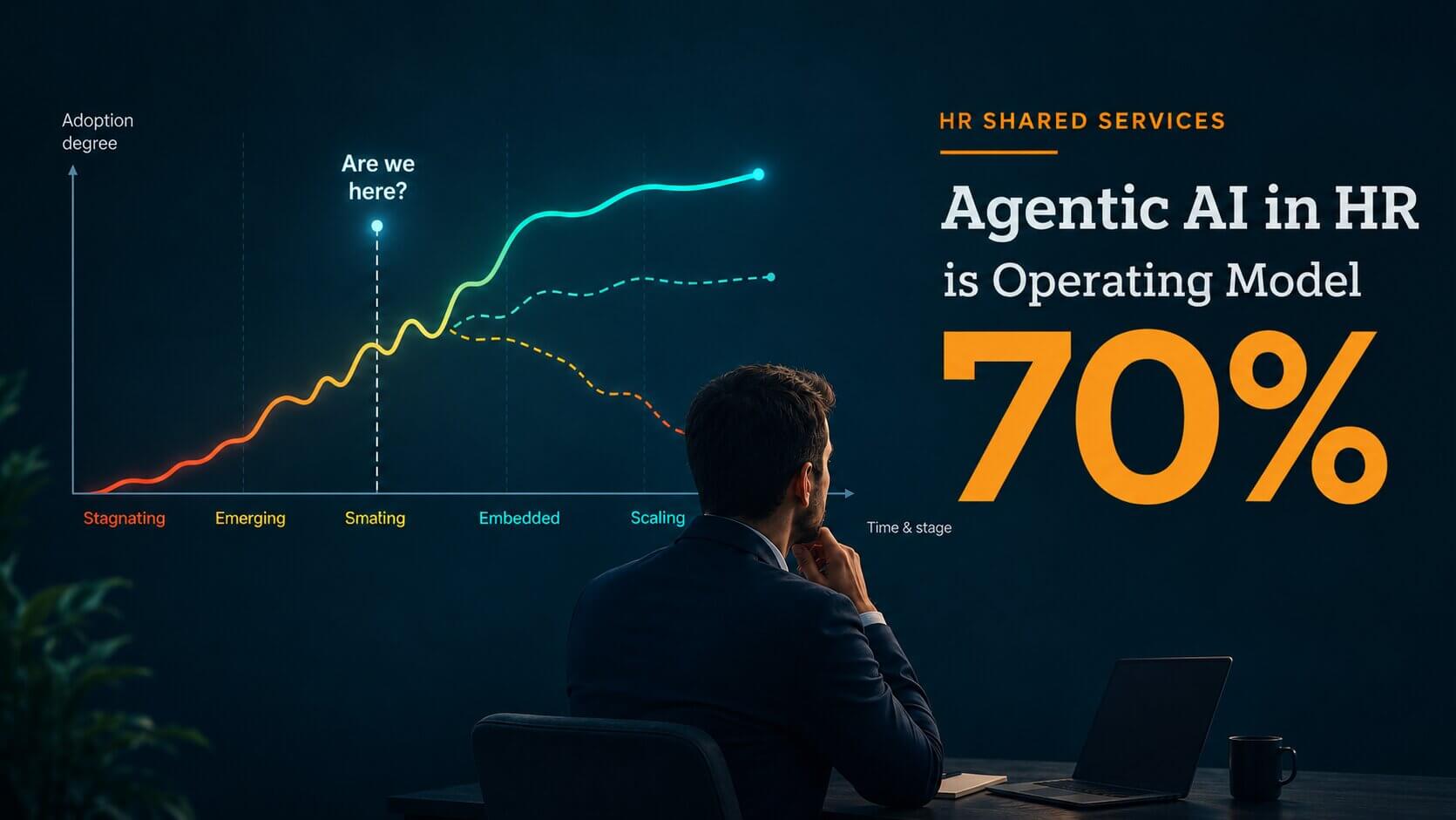
Most of my work is helping clients get AI past the slide deck and into something that actually ships. Over the last year the question coming across the table has changed. It used to be "which tool should we buy?" Now it is quieter and a lot harder: of all the money going into AI, where does it turn into real value, and which part of HR is ready to catch it first?
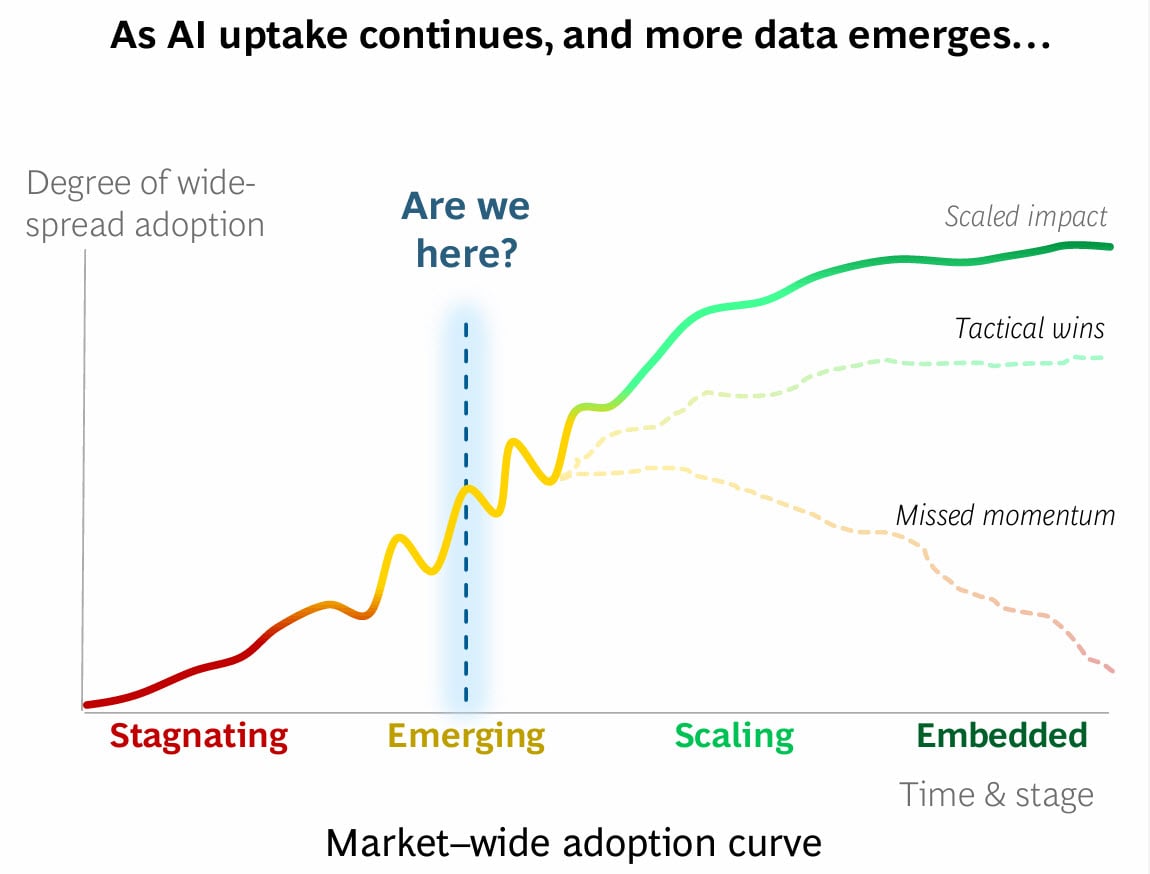
Source: BCG Executive Perspectives 2026, Unlocking Impact from GenAI and Agentic AI
I'll tell you where I've landed. Two of the most-discussed 2026 studies, BCG's HR report and Microsoft's Work Trend Index, come at that question from opposite ends and meet in nearly the same spot. Neither says the answer is a better model. Both say it's the operating model around it. And the place I keep watching that gap close fastest is HR shared services.
The 70/30 Constraint: Two 2026 Reports, One Conclusion
Honestly, the exact figure doesn't interest me much. What I care about is what it tells a CHRO to do differently: most of the value lives in the part you can't buy off a price list.
70 Percent of AI Value Sits in People and Process
BCG frames AI value creation with a model it calls 10-20-70. Algorithms account for 10 percent of the value, technology for 20 percent, and people, organisation, and process for the remaining 70 percent.
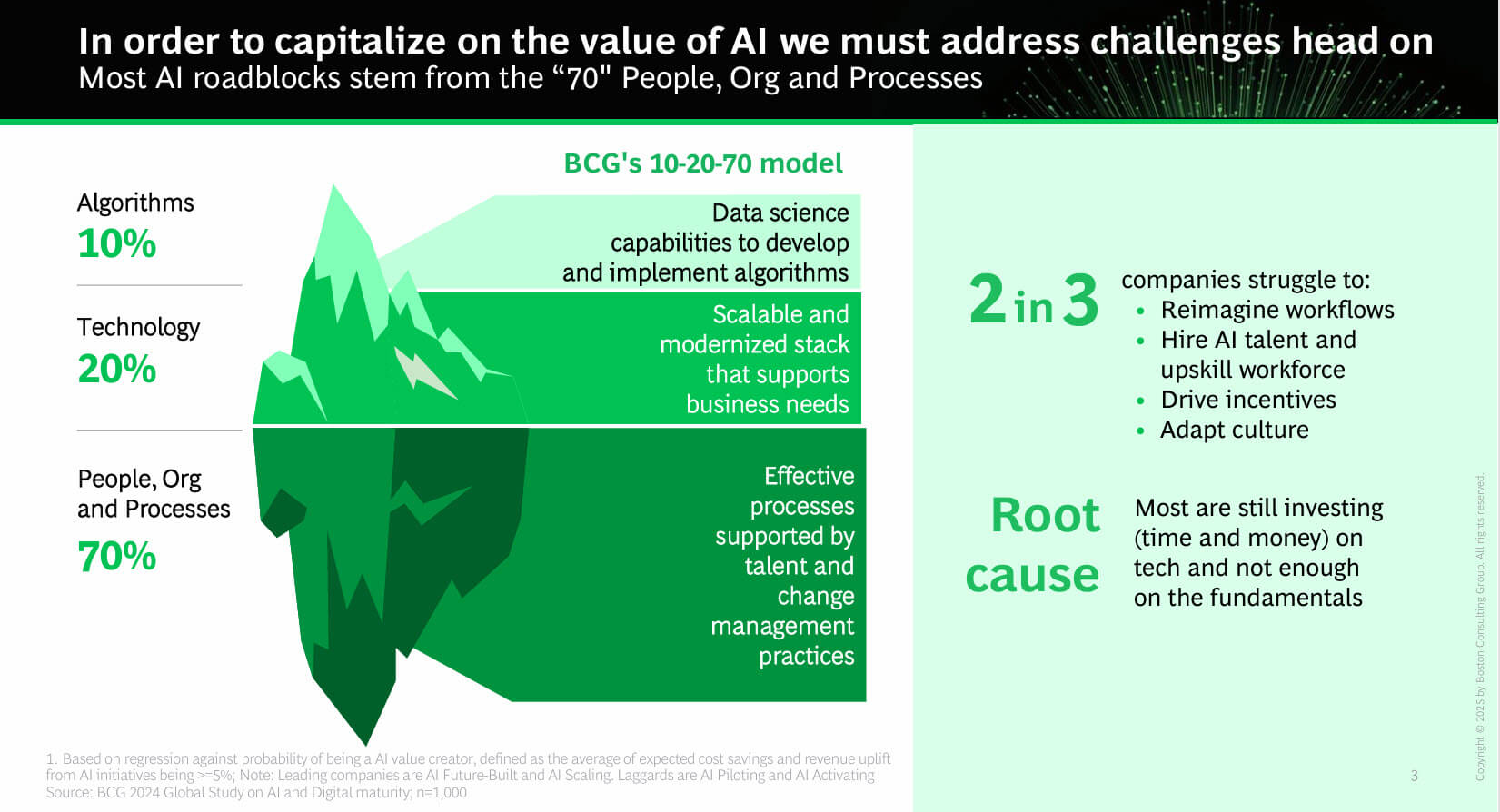
Source: BCG 2024 Global Study on AI and Digital maturity; n=1,000
This is the part most budgets get wrong. The biggest share of value sits in the things that are hardest to purchase: reimagined workflows, talent and upskilling, incentives, and culture. BCG found two in three companies struggle with exactly those. Its own diagnosis is blunt: most are still spending on tech and not enough on the fundamentals.
So for HR the starting question isn't "which AI tool." It's whether the workflow, the roles, and the governance around that tool are built to let it pay off.
Org Conditions Drive 67 Percent of AI Impact
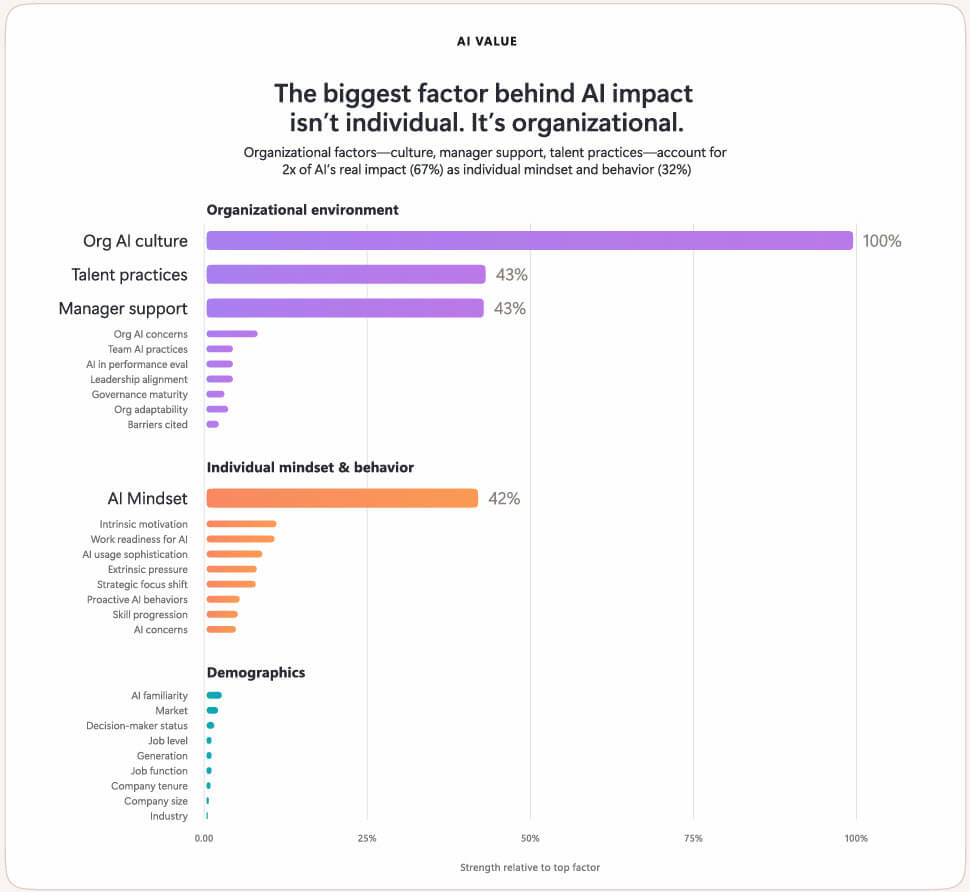
Source: Microsoft 2026 Work Trend Index; n=19,854 analysed (20,000 surveyed across 10 markets)
Microsoft gets to almost the same place from a completely different method. They ran an importance analysis across 29 factors to see what predicts whether people report real impact from AI. Organisational factors came out at 67 percent. Individual factors, 32 percent.
Organisational factors are the things the company controls: AI culture, manager support, how AI shows up in how people are evaluated and developed. Individual factors are what the employee brings: attitude, skill, proactivity.
The ranking is what stayed with me. The strongest single factor is organisational AI culture, at 100 percent relative strength. Manager support and talent practices follow at 43 percent each. The best individual factor, AI mindset, comes in at 42, behind all three organisational ones.
"The real question isn't whether people have the right skills. It's whether the organization is built to unlock them"
Microsoft, 2026 Work Trend Index
Microsoft call this a statistical association. But the direction is hard to argue with: the same person, with the same tools, gets roughly twice the measurable impact in a company that built the conditions for it. Two of every three levers are on the company's side of the table.
Why Agentic AI in HR Shared Services Lands Here First
If 70 percent of the value is workflow and conditions, you start where the workflow is already in decent shape. For HR, both reports point to the same function.
BCG Says Shared Services Is Already Live
BCG's case has three moves, and they're worth keeping apart.
What it says first: agent deployments are "underway in HR areas like recruiting and shared services already." Present tense. Not a forecast.
Why shared services is ready: in BCG's end-to-end HR maturity map, HR admin and shared services is one of the few areas rated "Tablestakes" on technology maturity, because mature tools for chatbots, routing, and case resolution already exist. Several other HR areas are still earlier-stage.
The destination BCG names for it is "independent agentic inquiry resolution and immediate automated support from hire to retire." It's close to how Azure AI is already being used in real recruitment and HR case work.
And the consequence: once the tooling is mature, the thing holding you back isn't technology anymore. It's workflow design and governance. That's the 70 percent again, and it's why shared services moves first.
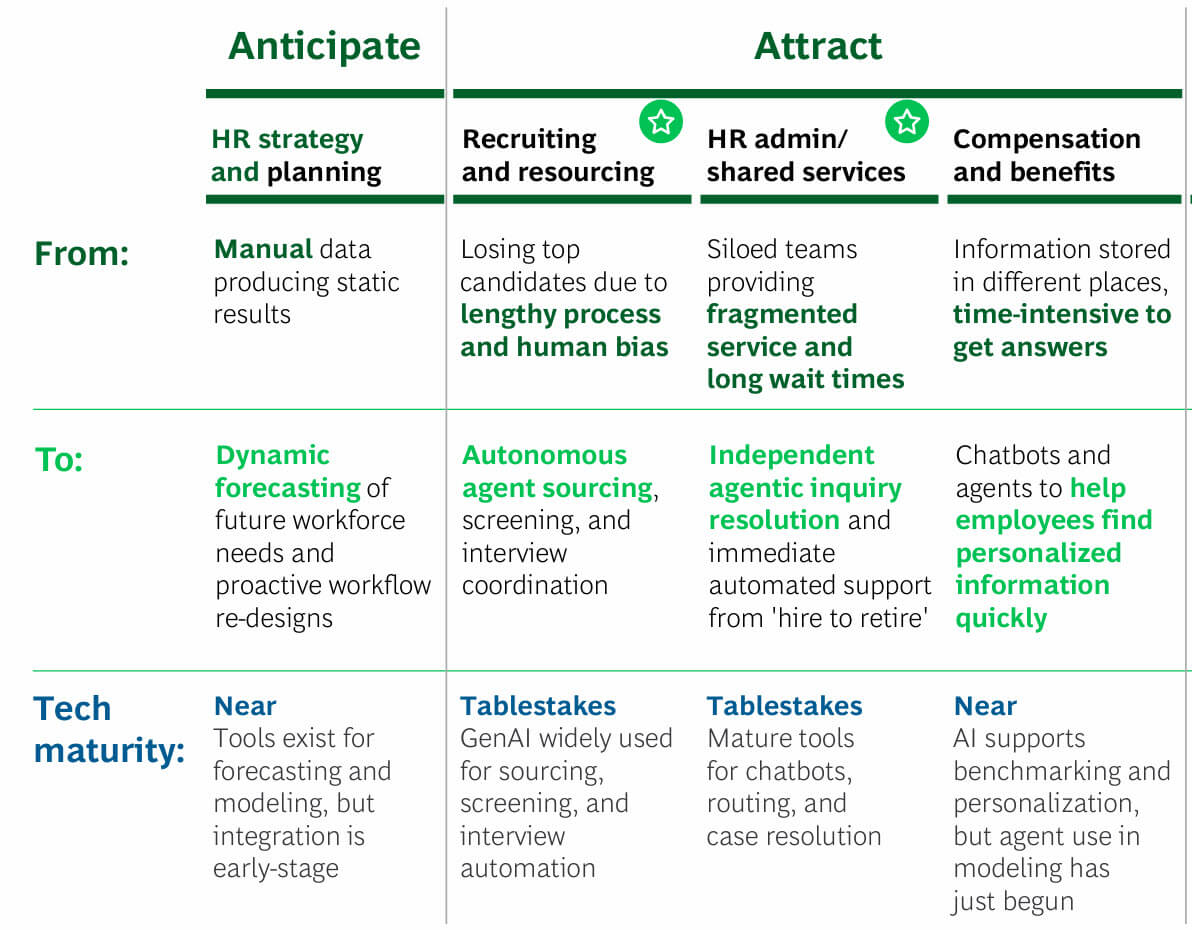
BCG's HR maturity assessment: where shared services stands
Source: BCG Executive Perspectives 2026, Unlocking Impact from GenAI and Agentic AI
The Agents Are Already Scaling, and the Work Is Cognitive
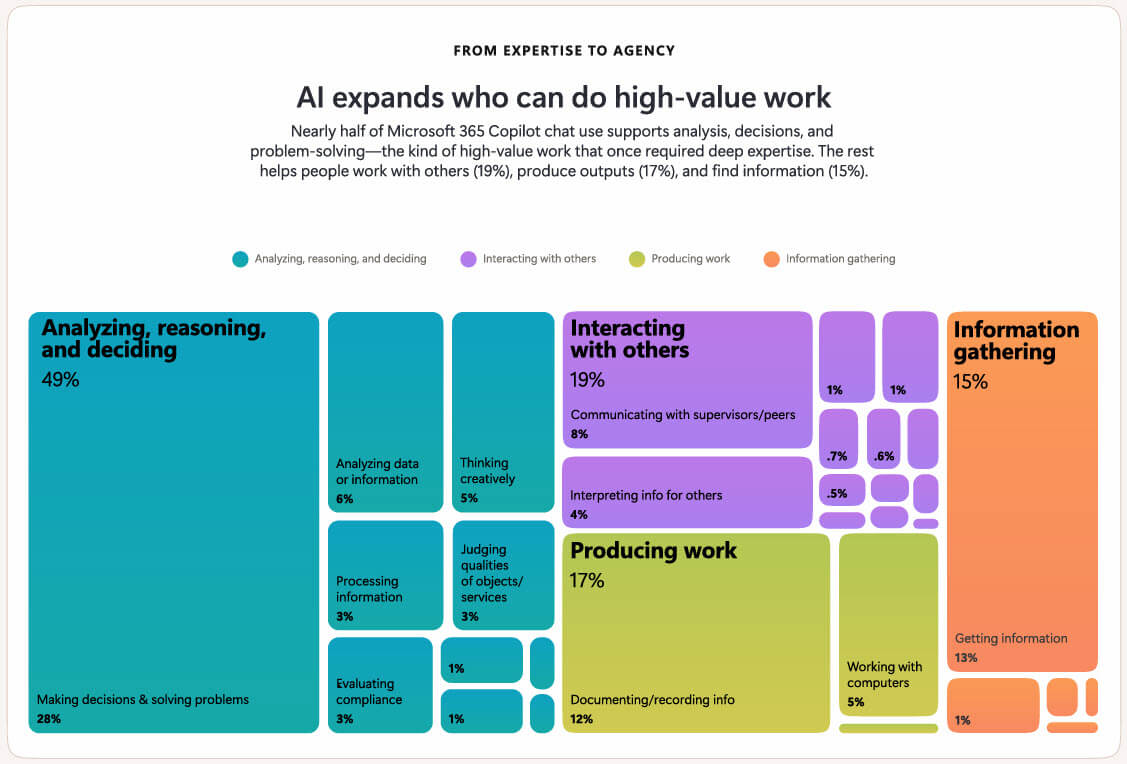
Source: Microsoft 2026 Work Trend Index, Copilot telemetry and agent growth data
Microsoft's numbers show the scaling is already underway. Active agents in the Microsoft 365 Copilot ecosystem grew 15x year over year, and 18x in large enterprises.
What those agents do is the part that matters for HR. A privacy-preserving analysis of more than 100,000 Copilot conversations found 49 percent support cognitive work: analysing, reasoning, deciding. Only 17 percent produce finished outputs. The single biggest activity, at 28 percent, is "making decisions and solving problems."
That is exactly what a shared services desk does all day. Read a policy, judge eligibility, decide what to escalate. The work agents are taking on is the work this function already runs.
The Four-Stage Maturity Ladder for HR Shared Services
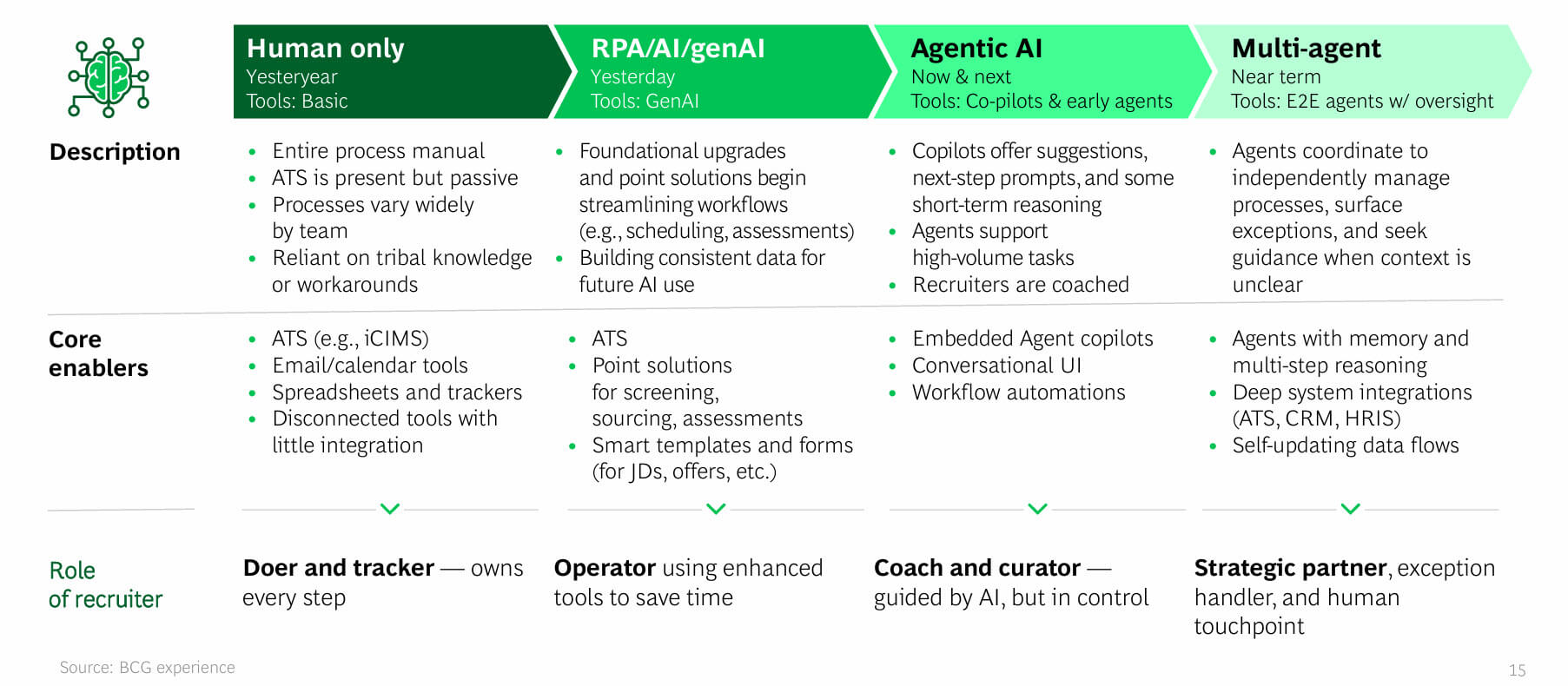
BCG's four-stage AI maturity ladder, illustrated with recruiting
Source: BCG Executive Perspectives 2026, Unlocking Impact from GenAI and Agentic AI
Before you design the target, be honest about where you actually are. In my experience most teams flatter themselves by a stage, because the label moves faster than the workflow underneath it. BCG's ladder is useful for exactly that reason: it forces the check, the same check a structured AI readiness assessment gives you.
There are four stages, and the human's job changes at each one.
Stage 1, Human-only. Everything is manual. Tools exist but sit passive, and the work runs on tribal knowledge. The human is the doer and tracker, owning every step.
Stage 2, RPA and GenAI. Point solutions and copilots speed up individual tasks like scheduling and drafting. The human becomes an operator using better tools to save time. Most HR shared services functions are here.
Stage 3, Agentic AI (single agent). Agents take on high-volume tasks and some short-term reasoning, and the system coaches the person. The human becomes a coach and curator, guided by AI but still holding the wheel.
Stage 4, Multi-agent. Agents coordinate to run processes on their own, surface exceptions, and ask for help when context is unclear. The human becomes a strategic partner and exception handler. Reaching it is where custom agentic AI solutions earn their keep.
Most organisations sit at Stage 2. So the real question is practical: what does Stage 4 look like once it's running?
Inside the Multi-Agent HR Shared Services Architecture
BCG doesn't leave Stage 4 abstract. It builds a worked example for HR admin and shared services, and it's worth following because it shows the operating model, not just the slogan.
What BCG's Example Shows
It starts with one message from an employee: "I submitted a request to transfer to the Boston office last month but haven't heard anything. Can you check the status?"
That one request wakes up a set of specialised agents:
- General HR Info: fallback for general employee questions
- HR Requests: handles inquiries like transfers and promotions
- Policy & Eligibility: clarifies policies, eligibilities, and timelines
- Transfer Status: tracks the progress of office or location transfers
- HRBP Connect: routes to the assigned HR business partner for follow-up
- Out-of-Scope: handles predefined topics outside the chat
The system finds the request logged on May 28, reports it's under review with HR coordinating with Boston, then offers three next steps: connect the employee to their HR business partner, remind the Boston team, or give estimated timelines. The employee never has to know which agent to ask. That coordination is the same discipline behind building enterprise multi-agent systems with confidence.
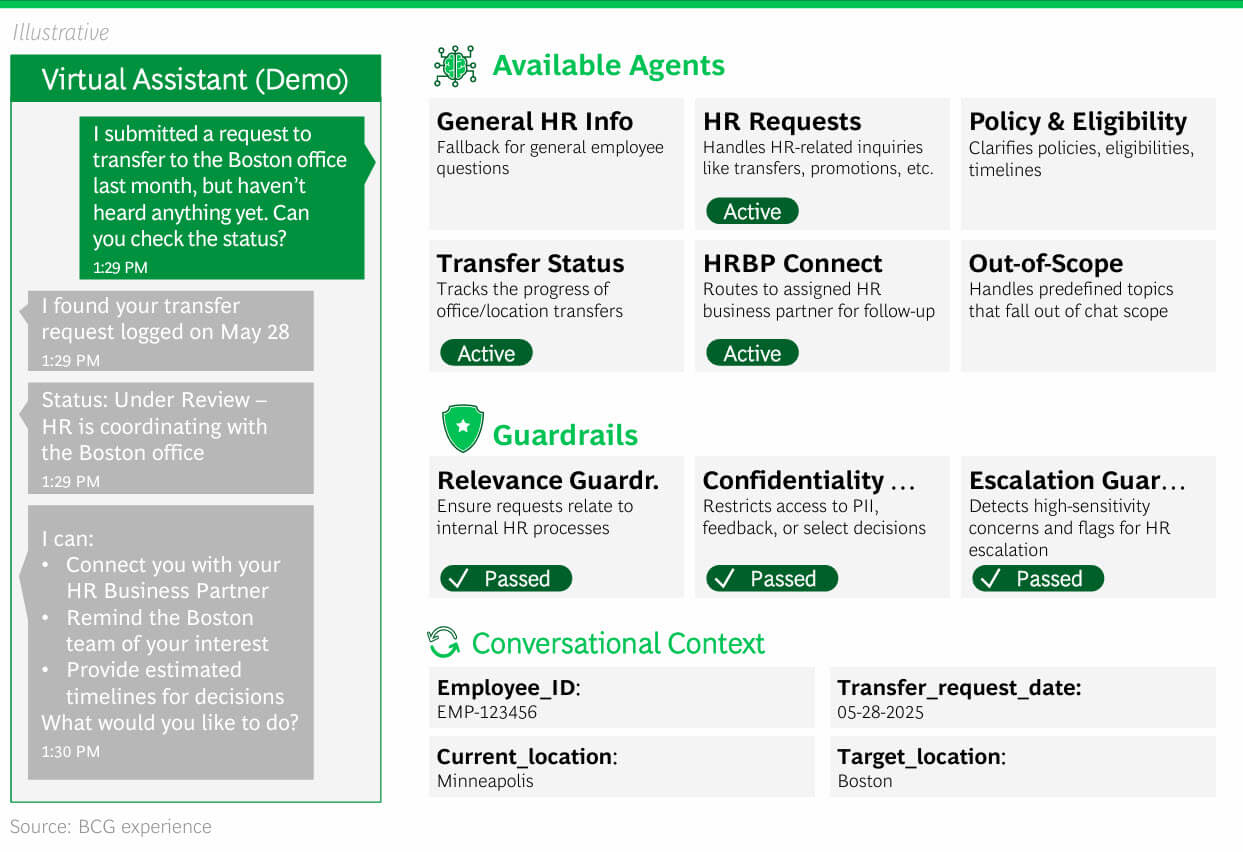
BCG's multi-agent HR shared services model
Source: BCG Executive Perspectives 2026, Unlocking Impact from GenAI and Agentic AI
The Governance Layer BCG Builds In
The architecture isn't only agents. BCG runs three guardrails before any sensitive action.
A Relevance guardrail keeps requests tied to internal HR processes. A Confidentiality guardrail limits agent access to PII, feedback, or select decisions. An Escalation guardrail catches high-sensitivity cases and hands them to a human.
Governance is built into the workflow, not bolted on later. In HR, where every interaction touches personal data, that ordering is the difference between a demo and something you can actually run, and it's why security and data governance for AI belongs in the design from day one.
Three Principles That Make It Scale
BCG names three design principles. One engagement activates the right agents, so a single request routes itself without the user navigating anything. Policy lives in the guardrails, so controls hold as volume grows. And the orchestration is reusable across personas, serving employees, managers, candidates, and internal teams from one foundation.
Those three are what separate a multi-agent system from a pile of chatbots. They're also where most of that 70 percent of design work actually sits.
Three Findings That Should Change HR Leadership Decisions
Everything above comes down to three decisions. Here they are in short, with the evidence after.
|
Finding |
Your decision |
|
Managers are the multiplier |
Invest in manager enablement before buying more tools |
|
Blocked Agency is a hidden risk |
Measure organisational readiness, not just individual skill |
|
Some firms are already redesigning |
Decide your posture now, before the gap compounds |
Managers Drive More AI Impact Than Any Individual Factor
In a separate study of 1,800 workers (819 leaders, 520 managers, 461 individual contributors), Microsoft pulled out the manager effect on its own. When managers actively modelled AI use, employees reported a 17-point lift in AI value, 22 points in critical thinking about their AI use, and 30 points in trust in agentic AI. Where managers made experimentation feel safe, people reported up to 20 points higher AI readiness.
It lines up with the main index, where manager support is a top-three organisational factor. If I could get a CHRO to spend the next quarter on one thing, it would be this. The cheapest, fastest lever in an agentic rollout isn't another platform. It's the managers who set the tone every day.
The Blocked Agency Zone Is a Risk Leaders Aren't Measuring
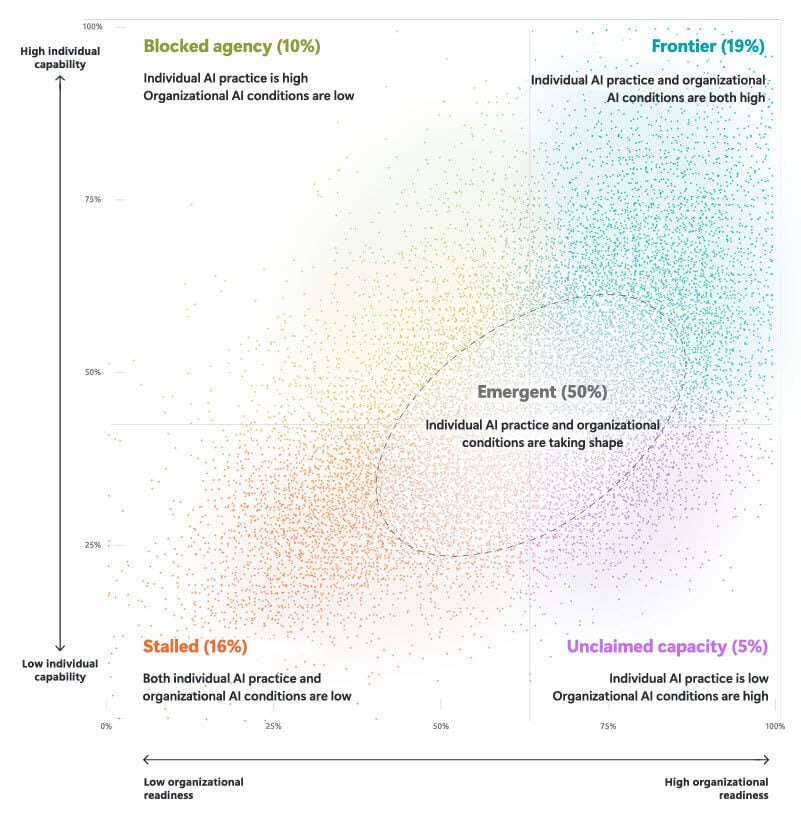
Microsoft's five readiness zones: where skilled workers get stuck
Source: Microsoft 2026 Work Trend Index, five-zone readiness map, n=16,971 plotted
In its 2026 Work Trend Index, Microsoft mapped its survey on two axes, individual capability and organisational readiness, and found five zones: Frontier 19 percent, Emergent 50, Blocked Agency 10, Stalled 16, Unclaimed Capacity 5.
Blocked Agency is the one I'd watch. These are people who've built real AI skills inside organisations that haven't caught up. Microsoft calls the wider pattern the Transformation Paradox: employees are ready to change how they work, but the system around them keeps rewarding the old way.
Microsoft's own measure of AI impact includes whether people feel "more likely to stay because of AI." So think about your sharpest employee, the one who taught herself to work with agents. Every day she hits a process that won't let her use what she knows. She's the first to start updating her CV, and the one you can least afford to lose.
I keep seeing companies celebrate a training-completion dashboard while nobody asks whether the organisation can actually use what these people have learned. That's why AI readiness matters more than strategy.
The Companies Already Redesigning Around AI
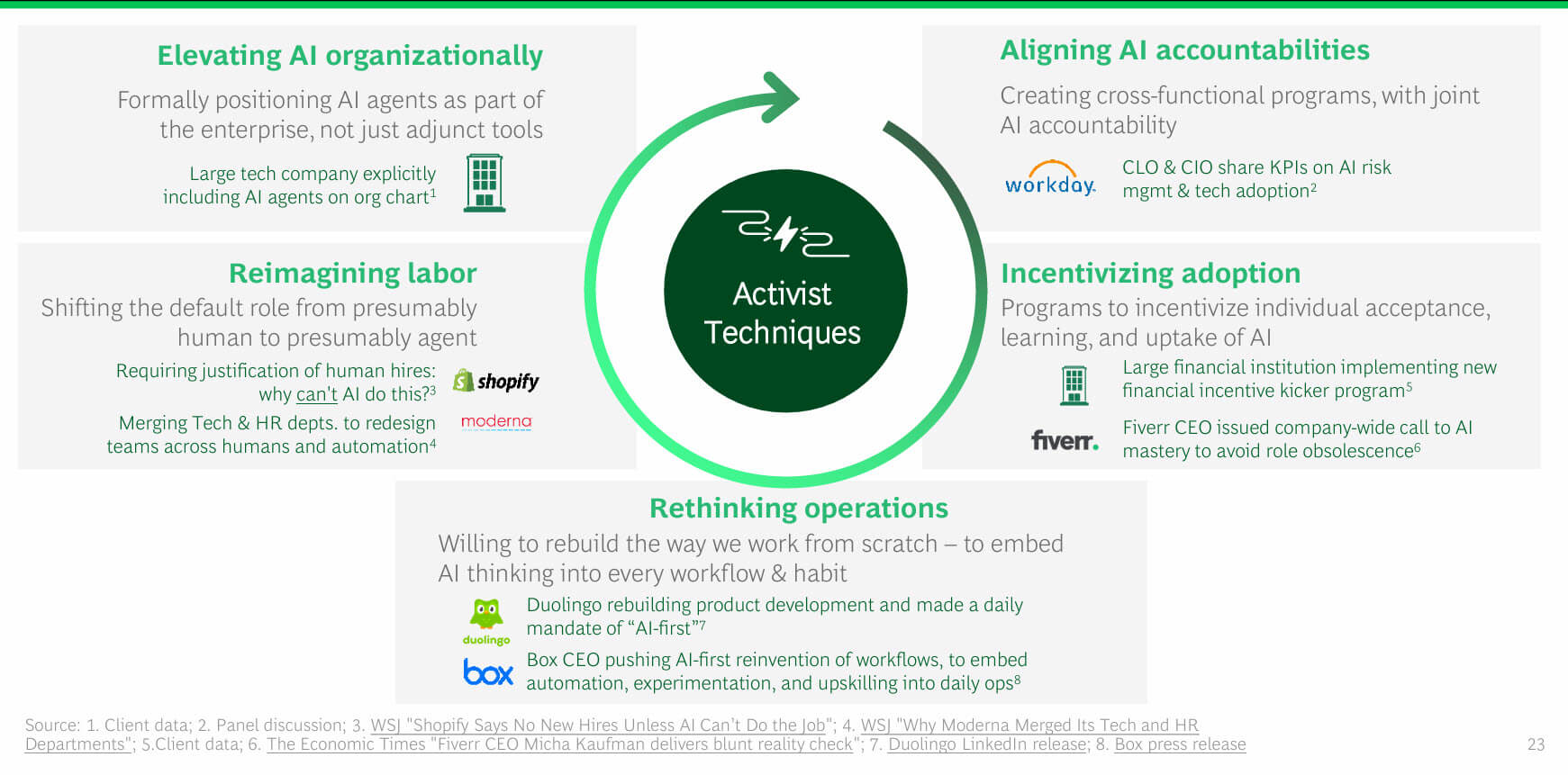
BCG's five activist techniques for working backward from AI-first
Source: BCG 2026, five activist techniques
BCG documents how the most aggressive companies work backward from an AI-first posture, with named examples.
- Reimagining labour: Shopify requiring justification for human hires, Moderna merging tech and HR.
- Elevating AI organisationally: a large tech company putting AI agents on the org chart.
- Aligning AI accountabilities: Workday's CLO and CIO sharing KPIs on AI risk and adoption.
- Rethinking operations: Duolingo's daily AI-first mandate, Box's AI-first reinvention.
- Incentivising adoption: a large financial institution's incentive program, Fiverr's company-wide call to AI mastery.
The pattern is consistent: these firms redesign the model around AI rather than bolt AI onto the model they already had. For HR leaders the question isn't whether to follow. It's how far behind you're willing to be.
Conclusion
BCG puts the multi-agent shift in HR shared services in the present tense. Microsoft's data shows why this kind of cognitive work compounds into know-how a competitor can't easily copy. What's left to decide isn't the technology. It's whether your workflow, your governance, and your managers are ready for it.
We work on exactly these questions in our client deliveries, and I see more CHROs and digital leaders facing the same call every month. Precio Fishbone helps teams across the Microsoft stack move from scattered pilots to one governed, repeatable approach.
Contact to our expertsWe help organisations move from AI and Microsoft strategy to implementation that holds up in production. To talk through what this means for your environment, contact our team.
Frequently Asked Questions
What is agentic AI in HR shared services?
A model where several specialised AI agents coordinate to resolve employee HR requests end to end, like transfers or policy questions, with governance guardrails built in. One employee message routes itself to the right agents, with no human triage
Is agentic AI in HR shared services actually being deployed today?
Yes. BCG's February 2026 HR report says agent deployments are already underway in shared services and rates the function's tooling as mature. Microsoft reports active agents in its ecosystem grew 15x year over year, and 18x in large enterprises.
How does a multi-agent HR system connect to our existing HRIS?
On the Microsoft stack, agents built on Azure AI Foundry and Copilot Studio connect to HR systems through APIs and Microsoft Graph, with identity and policy enforced centrally. Precio can confirm the right integration pattern for your specific HRIS and data residency needs.
What governance does agentic AI in HR shared services require?
At a minimum, guardrails for relevance, confidentiality, and escalation, so agents only act on in-scope requests, never expose sensitive data, and flag high-sensitivity cases to a human. For EU operations, HR-related AI is treated as high-risk under the EU AI Act, which adds logging and traceability obligations. HR has to own this, not delegate it.
How do we know if our organisation is ready for it?
Microsoft names three questions that tell you whether you're building durable capability: who reviews agent performance, who can update the workflows agents run, and how a local win gets captured and scaled. Organisations that can answer them are building what Microsoft calls Owned Intelligence: know-how that's unique to the firm and hard to replicate.
Share this on

Pär Johansson
Pär works with international business at Precio Fishbone, project delivery & digital services, helping turn complexity into progress and strategy into long-term value. With many years of experience in international business, He is known for building strong relationships and turning plans into meaningful progress. Driven by people, trust and sustainable growth.