There is a point in almost every agentic AI project where you realize you have accidentally built a platform before building your actual product.
You sat down to create something useful. Maybe an internal tool, a custom workflow, or a smarter interface for your team.
But somewhere between managing context across turns, wiring up tool calls, handling multi-model routing, integrating MCP servers, and thinking through permission boundaries and failure modes, the work shifted.
Now you are maintaining infrastructure. The thing you actually wanted to build is still waiting.
That is the problem GitHub is addressing with the Copilot SDK, currently in technical preview.
What the SDK Actually Is
The GitHub Copilot SDK is not a new AI model, and it is not a standalone product.
It is better described as a programmable layer that gives developers direct access to the same agentic execution core that powers GitHub Copilot CLI.
That distinction matters more than it might seem at first.
The SDK takes that same core and makes it embeddable. Instead of building your own planner, tool orchestrator, and runtime from scratch, you drop the Copilot agentic core into your application and build on top of it.
The result is that your application gains the ability to plan, invoke tools, edit files, and run commands, without you having to design and maintain the execution layer underneath.
The Problem It Solves Is Real
To understand why this matters, it helps to be honest about how hard agentic workflows actually are to build well.
The surface-level pieces are not the hard part. Calling an API, getting a response, displaying it to a user: straightforward. The hard part is everything that happens when the task spans multiple steps, involves external tools, or needs to recover when something fails.
Managing context across turns means deciding what to keep, what to summarize, and what to discard as sessions grow longer.
Orchestrating tools means knowing when to invoke them, how to handle errors, and how to sequence calls that depend on each other.
Routing between models means understanding which model fits which part of a task and switching cleanly. Permissions mean deciding what an agent is and is not allowed to do, and making sure those boundaries hold.
Each of these is solvable on its own. Together, they constitute a significant engineering investment that sits entirely outside your actual product logic.
The Copilot SDK is GitHub's answer to whether every team building agentic applications should have to solve all of this independently.
What You Get Out of the Box
According to GitHub, the SDK ships with several capabilities worth understanding in concrete terms.
Multi-model support means you are not locked into a single model choice. You can route different parts of a task to different models, and the execution loop handles that coordination.
MCP server integration means the SDK connects to Model Context Protocol servers. This is increasingly how tools, context sources, and external integrations are being standardized in the agentic ecosystem.
GitHub authentication is handled natively, which matters if you are building anything that touches GitHub resources or operates within an organization's existing access controls.
Real-time streaming is included, so responses surface progressively rather than forcing users to wait for a complete output.
The entire thing works within your existing GitHub Copilot subscription. Alternatively, you can bring your own API key if you prefer to manage model access independently.
Language Support and Getting Started
The SDK launches with support for Node.js, Python, Go, and .NET. For most teams, at least one of those will fit naturally into an existing stack.
The official repository at github/copilot-sdk includes setup instructions, starter examples, and SDK references for each supported language.
GitHub's recommended starting point is deliberate: pick one specific task, such as updating files, running a command, or generating a structured output. Let Copilot handle the planning and execution while your application supplies the domain-specific tools and constraints.
That framing is worth taking seriously. A narrower first task gives you a working integration quickly, and a clear view of how the execution loop behaves before you build more logic on top of it.
The TypeScript integration looks like this in practice:
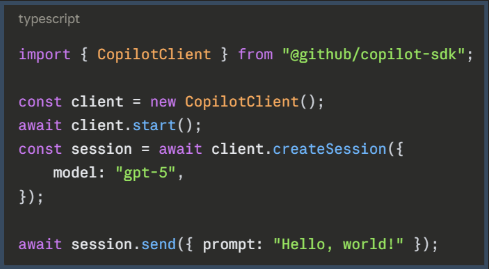
A few lines of setup to get a running session with model selection already wired in. From that point, the session handles the execution loop, tool invocation, and context management. Your code focuses on what it needs to do.
What Teams Have Already Built With It
GitHub's teams have already used the SDK to build a range of things, and the examples give a useful sense of how broad the scope actually is.
The list includes YouTube chapter generators, custom GUIs for agent workflows, speech-to-command tools that run applications from voice input, games built around competing with AI, and summarization tools.
These are not all enterprise workflow examples, and that is the point. The SDK is designed to be useful wherever agentic behavior makes sense, whether internal productivity tooling, a consumer-facing feature, or something in between.
How This Fits Into the Broader Copilot CLI Story
The SDK does not exist independently of Copilot CLI. It is specifically built on top of it, and understanding that relationship helps clarify what you are actually getting.
Copilot CLI has been expanding its agentic capabilities. Persistent memory, infinite sessions, and intelligent context compaction mean it handles longer-running tasks without losing coherence.
Explore, plan, and review workflows let you choose which model handles which phase of a task. Custom agents, agent skills, full MCP support, and async task delegation let it operate with meaningful autonomy.
The SDK takes all of that and makes it accessible programmatically, in your language, inside your application.
GitHub handles authentication, model management, MCP server connections, custom agent configuration, and streaming. Your application handles what gets built on top.
That division of responsibility is the core proposition. The execution platform is provided. The product logic is yours.
Who This Is Actually For
The SDK is most immediately useful for developers who have already tried to build agentic workflows and run into the complexity wall.
If you have spent real time on context management, tool orchestration, or failure handling in an AI workflow, the value of having that infrastructure provided is obvious.
For developers earlier in their exploration of agentic AI, it is also worth paying attention to. Avoiding the pattern of building an execution platform before building your actual product represents real leverage.
The GitHub Copilot SDK is in technical preview now. If multi-step AI execution, tool use, or file and command operations are part of what you are building, the github/copilot-sdk repository is a good place to start.
Thinking about how agentic AI fits into your product or internal tooling?
At Precio Fishbone, we help teams navigate the practical realities of building with AI, from architecture decisions to implementation. Let us know what you are working on.
Connect with usShare this on

Pär Johansson
Pär works with international business at Precio Fishbone, project delivery & digital services, helping turn complexity into progress and strategy into long-term value. With many years of experience in international business, He is known for building strong relationships and turning plans into meaningful progress. Driven by people, trust and sustainable growth.